
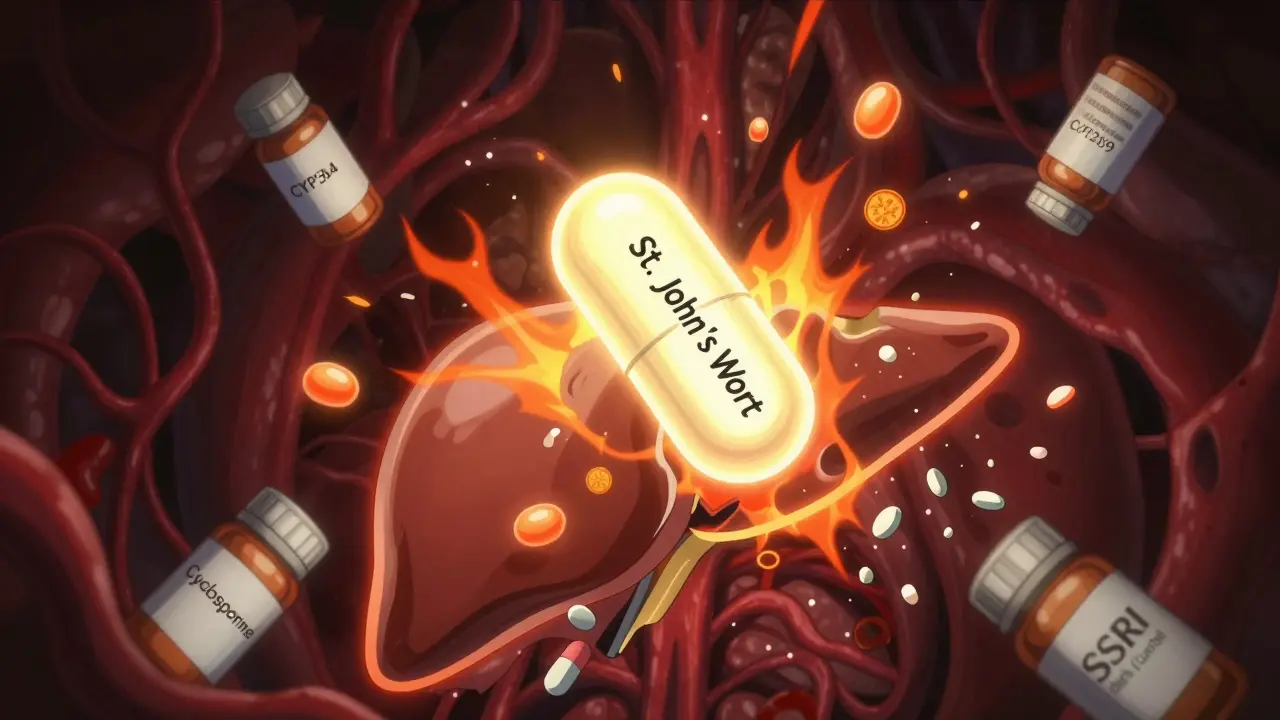
St. John’s Wort might seem like a safe, natural way to lift your mood-especially if you’ve heard it works for mild depression. But here’s the truth most labels won’t tell you: St. John’s Wort doesn’t just float gently alongside your pills. It actively fights them. And in some cases, it can make life-saving medications useless.
How St. John’s Wort Changes How Your Body Handles Medications
St. John’s Wort doesn’t just sit there. It turns on a switch in your liver called the pregnane-X-receptor, or PXR. When this switch flips, your body starts producing more of certain enzymes-especially CYP3A4, CYP2C9, and CYP1A2. These enzymes are like trash disposals for drugs. They break down medications so your body can flush them out. When St. John’s Wort turns them up full blast, your pills get cleared too fast. They never reach the level they need to work.The main culprit? Hyperforin. It’s the compound in St. John’s Wort that triggers this reaction. Most supplements contain 2-5% hyperforin. That’s enough to make a huge difference. One study showed that after just 10 days of taking St. John’s Wort, the blood levels of cyclosporine-a drug transplant patients rely on to keep their new organs from being rejected-dropped by nearly 50%. That’s not a small drop. That’s a medical emergency.
The Medications That Can Fail Because of St. John’s Wort
This isn’t theoretical. Real people have lost transplants, had unintended pregnancies, and suffered blood clots because of this interaction.- Immunosuppressants like cyclosporine, tacrolimus, and sirolimus: These drugs keep your body from attacking a transplanted organ. St. John’s Wort can slash their levels by up to 70%. There are documented cases of kidney and heart transplant patients rejecting their organs within weeks of starting the herb.
- Anticoagulants like warfarin: One patient’s INR (a measure of blood clotting) dropped from 2.5 to 1.4 in just 10 days after taking St. John’s Wort. That’s the difference between safe blood thinning and dangerous clotting.
- Oral contraceptives: Birth control pills rely on steady hormone levels. St. John’s Wort speeds up their breakdown. There are dozens of reports of women getting pregnant while on the pill-while also taking St. John’s Wort for depression.
- Antidepressants: SSRIs like sertraline or fluoxetine, SNRIs like venlafaxine, even tricyclics. Mixing them with St. John’s Wort can push serotonin levels too high. That’s serotonin syndrome: high fever, rapid heartbeat, seizures, and in worst cases, death.
- HIV medications: Protease inhibitors like ritonavir and non-nucleoside reverse transcriptase inhibitors like efavirenz. St. John’s Wort can cut their levels so low that the virus rebounds, leading to drug resistance.
- Pain medications: Oxycodone, methadone, tramadol. These rely on CYP3A4 to be activated. St. John’s Wort breaks them down before they can work. Patients report sudden, unexplained pain returning after starting the herb.
Drugs.com lists 128 interactions with St. John’s Wort. 28 of them are labeled “major.” That’s more than any other herbal supplement. Even SAM-e and 5-HTP, which are also used for mood, have far fewer documented interactions.

Why This Is Worse Than You Think
Most people don’t realize the delay. You don’t wake up one morning and feel your pill isn’t working. It takes about 10 days for St. John’s Wort to fully turn on those enzymes. And even after you stop taking it, the effect lingers for up to two weeks. So if you quit the herb before surgery-or before starting a new drug-you’re not out of the woods yet.And here’s the scary part: no one checks. In the U.S., St. John’s Wort is sold as a supplement. That means no FDA approval, no mandatory interaction warnings on the bottle, and no pharmacist review before you buy it. You can walk into a store, pick it off the shelf, and start taking it without telling your doctor. Meanwhile, in the UK and EU, labels are required to warn about interactions with birth control, transplant drugs, and blood thinners. But in the U.S.? Often, it just says “for mood support.”
A 2019 poison control report tells the story: a 34-year-old woman got a kidney transplant. Her tacrolimus levels were stable. Then she started St. John’s Wort for “a little anxiety.” Eight weeks later, her body rejected the kidney. Her tacrolimus level? Below the danger threshold. She needed emergency treatment. She survived-but only because it was caught in time.
Who’s Taking It-and Why
About 4.7% of U.S. adults use St. John’s Wort. Most are women between 35 and 54. They’re often trying to avoid the side effects of antidepressants-weight gain, sexual dysfunction, emotional numbness. And yes, for mild depression, it can work. Studies show it’s as effective as some SSRIs for low to moderate cases.But here’s the trade-off: in Germany, where it’s prescribed like a drug, it accounts for 20% of all antidepressant treatments. In the U.S., usage has dropped 37% since its peak in 2000-not because it stopped working, but because people started dying.
On Reddit, users split: 68% say it helped their mood. But 32% admit to bad side effects. One woman wrote: “I took it with my birth control. Got pregnant. Didn’t know it could do that.”

What to Do Instead
If you’re on any prescription medication, don’t take St. John’s Wort. Period.Here are safer alternatives:
- SAM-e: Works for depression with minimal drug interactions. Only known risk is with MAO inhibitors-which most people aren’t on anyway.
- 5-HTP: A serotonin precursor. Fewer interactions than St. John’s Wort, but still use caution with antidepressants.
- Cognitive behavioral therapy (CBT): Proven, drug-free, and effective. Many insurance plans cover it now.
- Exercise: Just 30 minutes of brisk walking five days a week can be as effective as antidepressants for mild depression.
If you’re already taking St. John’s Wort and a prescription drug, don’t stop cold turkey. Talk to your pharmacist or doctor. They can help you taper off safely and monitor your medication levels. Blood tests for drugs like tacrolimus or warfarin are easy-and life-saving.
The Bottom Line
St. John’s Wort isn’t harmless. It’s a powerful enzyme inducer. It doesn’t play nice with medications. It’s not “natural” in the way people think. It’s a drug-just not one that’s regulated like one.If you’re not on any prescription meds, and you’re using it for mild depression, you might be fine. But if you take even one pill daily-birth control, blood pressure, cholesterol, antidepressant, transplant drug-you’re playing Russian roulette with your health.
The FDA warned about this in 2000. The European Medicines Agency followed in 2004. Yet, people still don’t know. Don’t be one of them. Ask your pharmacist: “Does this interact with anything I’m taking?” And if they say no, ask again. Because sometimes, they don’t know either.
Can I take St. John’s Wort with antidepressants?
No. Combining St. John’s Wort with SSRIs, SNRIs, or other antidepressants can cause serotonin syndrome-a dangerous condition that raises your body’s serotonin to toxic levels. Symptoms include confusion, rapid heart rate, high blood pressure, muscle rigidity, and seizures. This isn’t a mild reaction. It can be fatal. The Mayo Clinic and Merck Manual both warn against this combination.
Does St. John’s Wort affect birth control?
Yes. St. John’s Wort increases the breakdown of estrogen and progestin in birth control pills, patches, and rings. This can cause ovulation to return, leading to unintended pregnancy. At least 17 documented cases in the U.S. alone involved women who got pregnant while on the pill and taking St. John’s Wort. The European Medicines Agency requires this warning on all labels in the EU. Don’t rely on birth control if you’re using this herb.
How long does it take for St. John’s Wort to interact with medications?
It takes about 10 days for St. John’s Wort to fully activate the liver enzymes that break down drugs. But the effect doesn’t stop when you stop taking it. The enzyme boost can last up to two weeks after discontinuation. So if you’re planning surgery or starting a new medication, you need to stop St. John’s Wort at least three weeks in advance.
Is St. John’s Wort regulated like a drug?
No. In the U.S., it’s sold as a dietary supplement, which means the FDA doesn’t review it for safety or interactions before it hits shelves. Manufacturers aren’t required to test for consistency, potency, or contamination. In the EU and UK, regulations are stricter: labels must warn about interactions with immunosuppressants, birth control, and blood thinners. But in the U.S., you might buy a bottle with no warning at all.
What should I do if I’ve been taking St. John’s Wort with my prescription meds?
Don’t stop suddenly. Contact your pharmacist or doctor. Ask for blood tests to check levels of your medications-especially if you’re on warfarin, cyclosporine, tacrolimus, or an antidepressant. Your provider can help you safely stop St. John’s Wort and adjust your prescription if needed. If you’ve had unexpected side effects-like breakthrough bleeding, increased pain, or mood changes-tell them. Those could be signs your meds aren’t working.
Are there any safe herbal alternatives to St. John’s Wort?
Yes. SAM-e has minimal drug interactions and is backed by research for mild depression. 5-HTP is another option, though it still carries some risk when mixed with antidepressants. Non-herbal options like cognitive behavioral therapy (CBT), regular exercise, and light therapy have strong evidence and zero interaction risks. Talk to your doctor about these before turning to herbs.


Caleb Sutton
February 2, 2026 AT 21:11They don't want you to know this because Big Pharma owns the FDA and the supplement industry is the only thing keeping small businesses alive. They'll let you die on a waiting list for a new kidney but god forbid you take a plant that actually works. This is control. Pure and simple.
Roshan Gudhe
February 4, 2026 AT 11:49It's fascinating how we treat plants as 'natural' and therefore harmless, yet ignore that they're biochemical powerhouses. St. John’s Wort isn't magic-it's pharmacology with roots. The real tragedy isn't the interaction-it's that we've outsourced our health literacy to corporations and regulators who profit from our ignorance. Knowledge isn't optional anymore. It's survival.
Rachel Kipps
February 6, 2026 AT 01:17i read this and just felt so scared. i was taking it for a while last year and im on blood pressure meds. i had no idea. i’ll call my dr tomorrow. thank you for writing this.
Prajwal Manjunath Shanthappa
February 6, 2026 AT 11:57Wendy Lamb
February 8, 2026 AT 02:20So many people don't realize how dangerous this is. I'm glad someone laid it out clearly. Just because it's herbal doesn't mean it's safe. Especially with meds.
Antwonette Robinson
February 9, 2026 AT 17:11Oh wow, a 128-interaction herbal supplement with zero labeling requirements? Who even thought that was a good idea? Next up: 'Magic Mushroom Tea for Cholesterol' with a sticker that says 'maybe works, maybe you die.'
Jhoantan Moreira
February 11, 2026 AT 02:35This is such an important post. I’ve seen friends take St. John’s Wort thinking it’s harmless, and honestly, I didn’t know the risks either until now. Thank you for the clarity. If you’re on meds, please, just ask your pharmacist. Even if they seem rushed-they’re your last line of defense.
Shelby Price
February 12, 2026 AT 07:05My mom took this with her antidepressants. She ended up in the ER. I didn’t know until months later. This should be on every bottle. Like, right on the front. Not buried in fine print.