

Head Injury Assessment for Blood Thinner Patients
Assess Your Risk After a Head Injury
If you're on blood thinners and have had any head injury, even minor, this tool will help determine if you need immediate medical attention.
Based on guidelines from the American College of Emergency Physicians (ACEP) and Washington State Department of Health.
Risk Assessment Result
Select all symptoms that apply and click "Assess Risk" to see your results.
When you're on blood thinners-whether it's warfarin, rivaroxaban, apixaban, or another anticoagulant-a simple fall, bump, or head impact can turn into a medical emergency. These medications prevent dangerous clots, but they also make bleeding harder to stop. That’s why even a minor head injury needs serious attention. Many people assume if they feel fine after a bump, they’re okay. But with blood thinners, that’s not true. Head injury in someone on anticoagulants carries a 2 to 3 times higher risk of internal bleeding in the brain compared to someone not on these drugs.
Why Even a Small Bump Can Be Dangerous
Think of your brain like a soft sponge inside a hard shell. A fall might not crack your skull, but it can still cause tiny tears in blood vessels. Normally, your body would seal those off quickly. But blood thinners stop that process. That’s why bleeding can start slowly, then grow over hours or even days. You might walk away from the fall feeling fine, only to develop a headache, confusion, or vomiting later. By then, it could be too late.
Studies show that about 1 in 10 emergency visits for head trauma involve someone on blood thinners. And among those, up to 15% end up with bleeding inside the skull-even if they didn’t lose consciousness or seem badly hurt. That’s why guidelines now say: if you’re on anticoagulants and hit your head, get a CT scan. No exceptions.
When to Get a CT Scan: The Clear Rules
There’s no room for guesswork. If you’re on blood thinners and have any head injury, you need immediate imaging. The most widely accepted guidelines-from the American College of Emergency Physicians (ACEP) and the Washington State Department of Health-agree on this:
- You had any loss of consciousness, even for a few seconds.
- You’re confused, dizzy, or not thinking clearly.
- You have nausea or vomiting-especially more than once.
- You have a visible bump, cut, or bruise on your head or neck.
- You fell from a height-like a ladder, stairs, or bed.
- You’re 65 or older.
- You’re on a direct oral anticoagulant (DOAC) like rivaroxaban or apixaban.
Even if none of these apply, if you’re on blood thinners and hit your head, the safest choice is still a CT scan. The Canadian CT Head Rule, often used for younger, healthy patients, doesn’t apply to you. It was never tested on people taking anticoagulants-and using it could miss serious bleeding.
What the CT Scan Shows-and Doesn’t Show
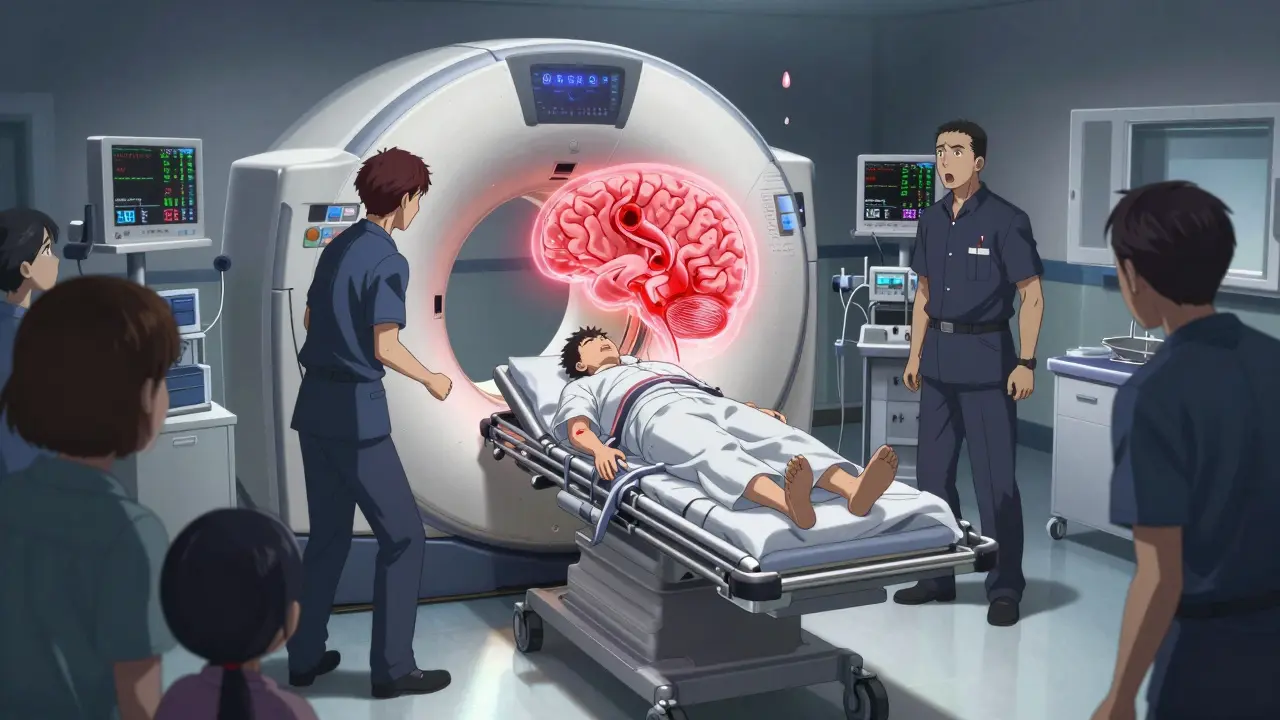
A non-contrast head CT is the gold standard. It’s fast, widely available, and picks up bleeding, swelling, or fractures. The scan uses thin slices-0.5 mm to 1.25 mm-specifically designed to catch small skull fractures and tiny bleeds. Radiologists are trained to look for subtle signs, like a small spot of blood near the brain’s surface.
But here’s the catch: a normal CT scan doesn’t mean you’re completely out of danger. About 0.5% to 1% of people on blood thinners with a clear initial scan still develop bleeding later. This can happen up to 72 hours after the injury. That’s why observation matters.
Observation: The Critical 6 to 24 Hours
Many hospitals now keep patients under observation for at least 6 hours after injury-even if the CT scan is normal. During this time, staff monitor your alertness, balance, speech, and vital signs. If you start to feel worse, they can act fast.
Some places, like Johns Hopkins and other major trauma centers, extend this to 24 hours. Why? Because delayed bleeding can happen days later, especially in older adults. A 2023 study found that 1 in 5 delayed bleeds occurred after the first 6 hours. The University of Texas protocol, still used by 78% of Level I trauma centers, recommends a 6-hour observation window before discharge-only if:
- CT scan is negative.
- No worsening symptoms during observation.
- INR is below 3.5 (if on warfarin).
- No other injuries requiring hospitalization.
If any of those conditions aren’t met, you stay. And if you’re on a DOAC, the rules are stricter. No exceptions.
The Balancing Act: Bleeding Risk vs. Clot Risk
Here’s the hardest part: stopping your blood thinner might seem like the safe choice. But it’s not. If you stop rivaroxaban or apixaban suddenly after a head injury, your risk of stroke or a clot in your lungs or legs skyrockets. One study followed a patient who stopped their DOAC after a negative CT-and had a stroke three days later.
Doctors now avoid reversing anticoagulation unless there’s active, life-threatening bleeding. Reversal drugs like Idarucizumab (for dabigatran) or PCC (for warfarin) carry their own risks. They’re not magic bullets. They’re used only when absolutely necessary and under specialist guidance.
What You Should Do After the Hospital
If you’re sent home with a normal CT scan, you still need to watch for red flags:
- Worsening headache, especially if it’s throbbing or doesn’t go away.
- Confusion, slurred speech, or trouble remembering things.
- Weakness on one side of your body.
- Seizure or loss of consciousness.
- Nausea or vomiting that returns.
- Unusual drowsiness or difficulty waking up.
If any of these happen, go to the ER immediately-even if it’s 2 a.m. or three days later. Don’t wait. Don’t call your doctor first. Head to the hospital.
What You Can Do Before the Injury
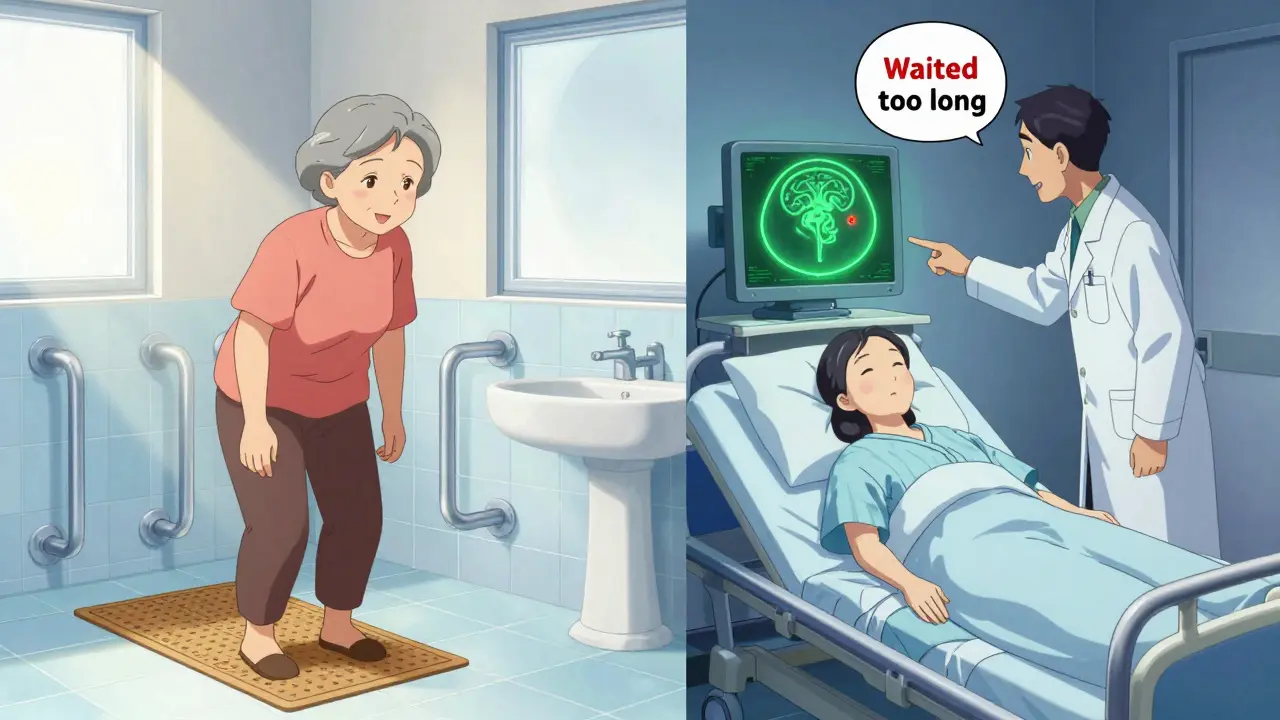
The best way to avoid this scenario? Prevent falls. If you’re on blood thinners, especially if you’re older:
- Remove tripping hazards from your home-rugs, cords, clutter.
- Install grab bars in the bathroom and handrails on stairs.
- Use non-slip mats in the shower.
- Get your vision checked yearly.
- Review your medications with your doctor-some drugs make you dizzy.
- Consider a balance assessment if you’ve had a fall before.
The CDC’s STEADI program (Stopping Elderly Accidents, Deaths & Injuries) offers free fall-prevention checklists for older adults. Talk to your doctor about whether you still need blood thinners-sometimes, the risks outweigh the benefits.
What’s Next: New Tools and Better Guidelines
Research is moving fast. The Banyan Brain Trauma Indicator, an FDA-approved blood test that measures brain proteins, is being studied for use in anticoagulated patients. If it works, it might one day help doctors decide who truly needs a CT scan. But right now, it’s not reliable enough for this group.
Dr. Ian Stiell’s team is working on a modified version of the Canadian CT Head Rule specifically for DOAC users. It’s expected to be ready by 2025. Until then, the safest rule is simple: if you’re on blood thinners and hit your head, get a CT scan. Don’t wait. Don’t hope it’ll pass. It won’t.
Do I need a CT scan if I only had a minor bump and no symptoms?
Yes. Even if you feel fine, the risk of delayed bleeding is real. Guidelines from ACEP and Washington State Health recommend immediate CT for all anticoagulated patients after head trauma, regardless of how minor it seems. Waiting for symptoms can be dangerous.
Can I just wait and see if I get worse?
No. Delayed intracranial hemorrhage can occur up to 72 hours after injury, and sometimes even longer. By the time symptoms appear, the bleeding may already be life-threatening. Immediate imaging is the only way to catch it early.
What if I’m on a DOAC like rivaroxaban? Is it safer than warfarin?
No. While DOACs don’t require regular blood tests like warfarin, they carry the same risk of bleeding after head trauma. In fact, because they’re harder to reverse quickly, some experts argue they’re riskier in trauma situations. A negative CT scan doesn’t mean you’re safe-observation is still needed.
Should I stop taking my blood thinner after a head injury?
Never stop your blood thinner without talking to your doctor. Stopping it suddenly can cause a stroke or pulmonary embolism. If you have bleeding, doctors may reverse it with specific drugs-but only under controlled conditions. Never make this decision on your own.
Is an MRI better than a CT scan for detecting bleeding?
MRI is more sensitive for small or old bleeds, but it’s not used in emergencies. CT scans are faster, more widely available, and better at spotting fresh bleeding. MRI might be used later for follow-up in stable patients, but never as the first test after trauma.
How long should I be observed after a head injury on blood thinners?
At least 6 hours, and often 24 hours. Many hospitals keep patients overnight, especially if they’re older, have other health problems, or are on DOACs. Observation includes checking your mental status, balance, and vital signs. If you’re stable and your CT is clear, you may be discharged-but only after this period.






Shaun Wakashige
March 21, 2026 AT 16:16Paul Cuccurullo
March 22, 2026 AT 17:18We live in a world where we are told to 'trust the science,' yet so many of us dismiss the very guidelines that could save our lives.
A bump on the head is not a nuisance-it is a whisper from your body saying, 'I am fragile now.'
To delay imaging is not bravery; it is ignorance dressed as pragmatism.
Let us not wait for tragedy to teach us what wisdom already knows.
We owe it to ourselves, to our families, to our future selves, to act with reverence for the body we have been given.
matthew runcie
March 24, 2026 AT 06:15Honestly, if you're on blood thinners, treat every head bump like it's a bomb. Better safe than sorry.
shannon kozee
March 25, 2026 AT 13:32Solomon Kindie
March 26, 2026 AT 22:58Natali Shevchenko
March 27, 2026 AT 03:06We don’t fear what we can’t see-so a tiny tear in a blood vessel, happening silently inside our skulls, feels abstract.
We’ve been conditioned to trust our senses: if I feel fine, I am fine.
But biology doesn’t care about our intuition.
The brain is not a muscle-it’s a cathedral of electrical storms, and blood thinners are like removing the firewalls from a system that was never meant to be left unguarded.
I think we need to reframe this: it’s not about fear.
It’s about humility.
To submit to the scan is to admit we are not in control.
And maybe that’s the bravest thing we can do.
trudale hampton
March 27, 2026 AT 13:16Also, my mom had a delayed bleed after a ‘minor’ bump. She’s fine now, but she spent 3 weeks in ICU.
Just do the scan. It’s one hour of your life. Worth it.
Johny Prayogi
March 28, 2026 AT 01:01I got hit in the head at a concert last year. Felt fine. Went to the ER anyway. CT showed a microbleed. They kept me overnight.
I’m alive because I didn’t listen to my ego.
Stop being a hero. Get scanned. Period. 💪🩺
Nicole James
March 28, 2026 AT 03:58Radiation exposure... cumulative damage...
And who profits from all these scans?
Hospitals? Insurance companies? The radiology techs?
What if the real danger isn’t the bleed… but the fear they’ve sold us?
I’ve read studies-some say observation alone, with serial neuro checks, is just as effective.
Why aren’t we talking about this?
Why is the narrative so rigid?
I’m not saying skip the scan-I’m saying question why we’re told to obey without thought.
Sandy Wells
March 29, 2026 AT 13:00If you’re old enough to need anticoagulants you should know better.
Falling down stairs? That’s not an accident.
That’s negligence.
And now we have to pay for your mistakes with ER resources.
Maybe stop taking the meds if you can’t handle basic safety.
Or move to a nursing home.