

Medication Tolerance Timeline Estimator
Use this tool to understand typical timelines for side effect tolerance based on common medication classes described in the article.
What Is Happening Biologically?
Your body adapts through two main pathways...
When Your Body Adjusts to Medicine
Have you ever started a new prescription and felt terrible for the first week? Maybe you felt dizzy, nauseous, or unusually sleepy. Then, after a couple of weeks, those symptoms fade away, yet the medicine still works. You aren't imagining things. This is a biological reality known as drug tolerancea pharmacological phenomenon where subjects exhibit a reduced reaction to a medication following its repeated use.. Understanding why your body adapts to some parts of a drug but not others can change how you manage your health plan.
The Basics of How Tolerance Works
Think of your body as a finely tuned security system. When a foreign substance enters-like a medication-it triggers alarms. Initially, these alarms are loud. That's the side effects you feel. Over time, your system learns to recognise the visitor. It doesn't want to sound the alarm every time the same person walks through the door. This adjustment happens through two main pathways. Scientists call them pharmacokinetics and pharmacodynamics.
Pharmacokinetics involves how your body processes the drug. Specifically, your liver gets better at breaking down chemicals. Enzymes called cytochrome P-450 work overtime. For example, when you take barbiturates repeatedly, your liver increases the production of these enzymes by up to 300%. The drug clears your system faster, so you feel less intense effects.
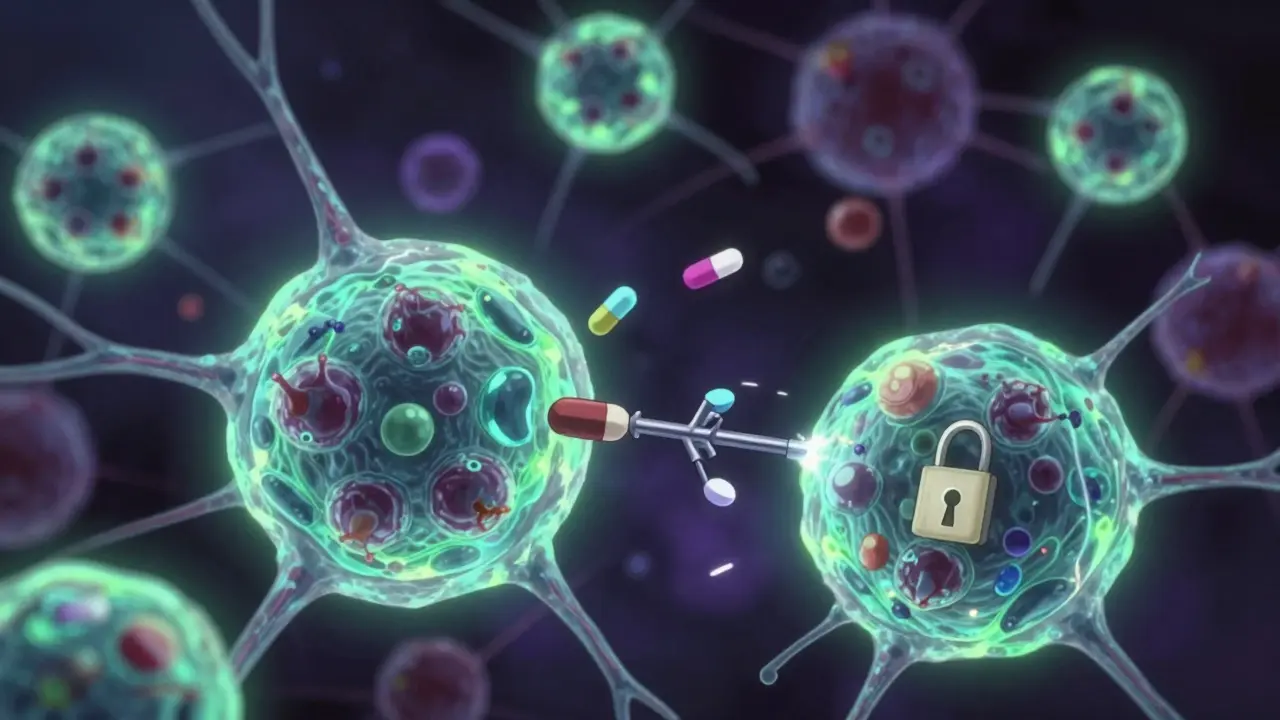
Pharmacodynamics deals with how the drug interacts with your cells. Imagine a lock and key. If the key fits too well initially, the cell changes the lock. This is receptor downregulation. The number of receptors on the surface of a nerve cell drops. If there are fewer locks, the key has nowhere to go, and the signal gets weaker.
| Mechanism Type | Primary Process | Timeframe |
|---|---|---|
| Pharmacokinetic | Faster metabolism by liver enzymes | Days to weeks |
| Pharmacodynamic | Receptor adaptation and cellular changes | Weeks to months |
| Cellular Adaptation | Changes in protein subunit composition | Chronic exposure |
Why Some Side Effects Vanish While Others Stay
This is where it gets interesting for patients. Not every symptom follows the same timeline. Researchers have identified something called differential tolerance, also known as unsympathetic tolerance. This means different systems in your body adapt at different speeds.
Consider opioids. They are powerful painkillers but come with a heavy cost. Many users report that severe nausea and vomiting stop within five to seven days of starting treatment. However, constipation often lingers for months or even years. Studies show that sedative effects drop by 70-80% within a week, while gastrointestinal issues remain at 90% of initial levels. Why? Because the brain circuits controlling nausea adapt quickly, but the gut receptors involved in bowel movements do not downregulate nearly as fast.
A similar pattern appears with antidepressants. Selective Serotonin Reuptake Inhibitors (SSRIs) often cause dizziness or sexual dysfunction early on. Surveys indicate that roughly 73% of patients develop tolerance to nausea within three weeks. Yet, about 58% continue to struggle with sexual side effects throughout their treatment. This variation is critical for managing expectations. You might expect all bad feelings to go away, but usually, only the acute ones do.
Differential Patterns Across Common Medications
Different classes of drugs behave differently regarding adaptation. Recognising the patterns helps you know when to wait and when to talk to your doctor.
- Benzodiazepines: Often used for anxiety. Tolerance to sleepiness develops rapidly. Within two weeks, sedative effects drop by 60%, but the ability to calm anxiety stays mostly intact (around 85-90%).
- Beta-Blockers: Prescribed for heart conditions. Fatigue is a common initial complaint. Most people see a reduction in fatigue by 65% within three months, but blood pressure control remains steady.
- Pregabalin: Used for nerve pain. Users frequently note dizziness improving after ten days, with 82% reporting complete resolution by day twenty-one.
This inconsistency is frustrating. One side effect leaves, another stays put. Knowing this distinction prevents panic when your medicine starts working on one front but not another.

The Role of Genes in Your Reaction
Your DNA plays a massive role in how fast you build resistance. It is not purely about lifestyle or dosage. Genetic polymorphisms affect enzyme function. About 7-10% of Caucasians and 1-2% of Asians carry variations in the CYP2D6 gene. These variations mean they are poor metabolizers.
If you fall into this group, codeine won't convert to morphine efficiently in your liver. Conversely, rapid metabolisers break down drugs too quickly. This explains why two people taking the exact same dose experience vastly different timelines for side effect disappearance. A study highlighted in 2023 notes that 30-40% of tolerance rates are purely inter-individual variability. There is no "average" patient response.
Managing the Changes Over Time
Clinicians are increasingly aware of these timelines. The FDA now requires tolerance timelines in prescribing information for many central nervous system drugs. When you visit a specialist, they should anticipate these shifts. For instance, if you are on long-term opioid therapy, a proactive plan often includes laxatives from day one because tolerance to constipation won't happen naturally.
Sometimes, the solution involves a "drug holiday." Stopping a medication for 7-10 days can reset the system. Nitroglycerin studies showed reversing tolerance by up to 60% using this method. However, never stop chronic meds without supervision. Withdrawal risks are real.
Innovations are also appearing. By 2024, researchers began testing polymer-encapsulated formulations designed to slow down absorption. These aim to reduce the speed at which tolerance builds to respiratory effects while keeping pain relief active. Personalised medicine is moving toward predicting these genetic markers before prescribing begins.
Does drug tolerance mean the medicine stops working?
Not necessarily. Tolerance usually applies to side effects first. Therapeutic efficacy often persists longer than adverse reactions. This is known as differential tolerance. Your pain relief might last while the nausea disappears.
Can I reverse tolerance by stopping the drug?
Short breaks, or drug holidays, can help restore sensitivity. For certain medications, a 7-10 day pause reverses 40-60% of tolerance. Always consult a doctor before attempting this to avoid withdrawal symptoms.
Why does constipation remain while other opioid side effects fade?
The brain and gut react differently. Neural pathways controlling nausea adapt quickly to the presence of opioids. The gut receptors controlling motility do not downregulate significantly, leading to persistent constipation.
Do genetic tests help predict side effects?
Yes. Tests for genes like CYP2D6 can identify poor or ultra-rapid metabolizers. By 2030, experts predict 40% of tolerance decisions will rely on such pharmacogenetic testing.
Is increasing the dose always the answer?
No. Raising the dose can accelerate tolerance further and may increase risk. Experts advise monitoring therapeutic goals rather than just chasing the initial intensity of sensation.






Tony Yorke
March 27, 2026 AT 10:09My dizziness vanished exactly when the timeline predicted it would.
Monique Ball
March 28, 2026 AT 21:36Tolerance development is a complex biological process indeed. Patients often notice changes within the first week. Side effects usually subside before the main action fades. My sister experienced nausea when starting her antidepressants. After three weeks she felt perfectly fine again. The sexual dysfunction however remained for a long time. It taught us to manage expectations realistically. Doctors should discuss these timelines earlier in treatment plans. Waiting for relief without knowing the schedule causes stress. Stress alone can mimic side effect symptoms sometimes. Genetic markers might dictate who tolerates drugs faster. Personalized medicine is becoming a reality slowly. Understanding these pathways empowers patients significantly. Knowledge reduces anxiety during the initial adjustment period. Sharing this data helps people prepare correctly.
Rohan Kumar
March 29, 2026 AT 11:30They say adaptation is natural but I doubt their motives 😒 Maybe it's just about keeping you buying more pills constantly.
Sabrina Herciu
March 30, 2026 AT 02:06You seem to misunderstand the basic science here!!! The body does not plot against you deliberately!!!! These mechanisms are evolutionary defenses against toxins!!!!! Please read studies before posting theories!!!!
Devon Riley
March 30, 2026 AT 18:54I am glad someone finally shared this information clearly 🙌 It gives hope to those struggling with new prescriptions really.
Debra Brigman
March 31, 2026 AT 04:12The dance between chemistry and cellular recognition is beautiful indeed. We are vessels of constant biological negotiation. Silence of the alarm signifies a truce formed by exposure. Tolerance is simply the mind learning peace with intrusion.
Jeannette Kwiatkowski Kwiatkowski
April 1, 2026 AT 20:04Common knowledge for anyone who has taken a pharmacology class honestly. People act surprised by basic receptor downregulation daily.
Aaron Olney
April 1, 2026 AT 20:42So basically the liver gets smart? Thats crazy honestly. I wonder if i can train my gut same way eventually.
Jordan Marx
April 3, 2026 AT 17:35Actually hepatic metabolism induction via CYP450 upregulation drives much of this kinetic tolerance. Your assumption oversimplifies the enzymatic cascade involved significantly. Downregulation is separate from metabolic clearance rates generally.
Sophie Hallam
April 5, 2026 AT 14:58I think both sides have valid points regarding patient experience versus clinical data. Finding balance between optimism and caution matters greatly.
Philip Wynkoop
April 6, 2026 AT 15:52Good read :)
gina macabuhay
April 7, 2026 AT 05:44Your arrogance is showing despite lacking proper credentials obviously. Stick to reading articles instead of teaching biology classes.
Austin Oguche
April 8, 2026 AT 02:54Thank you for sharing this educational resource with the community today. Health literacy improves outcomes across all cultures universally.
tyler lamarre
April 9, 2026 AT 23:04Most of this is already documented in standard textbooks from the nineties anyway. People love pretending they discovered something new constantly.