
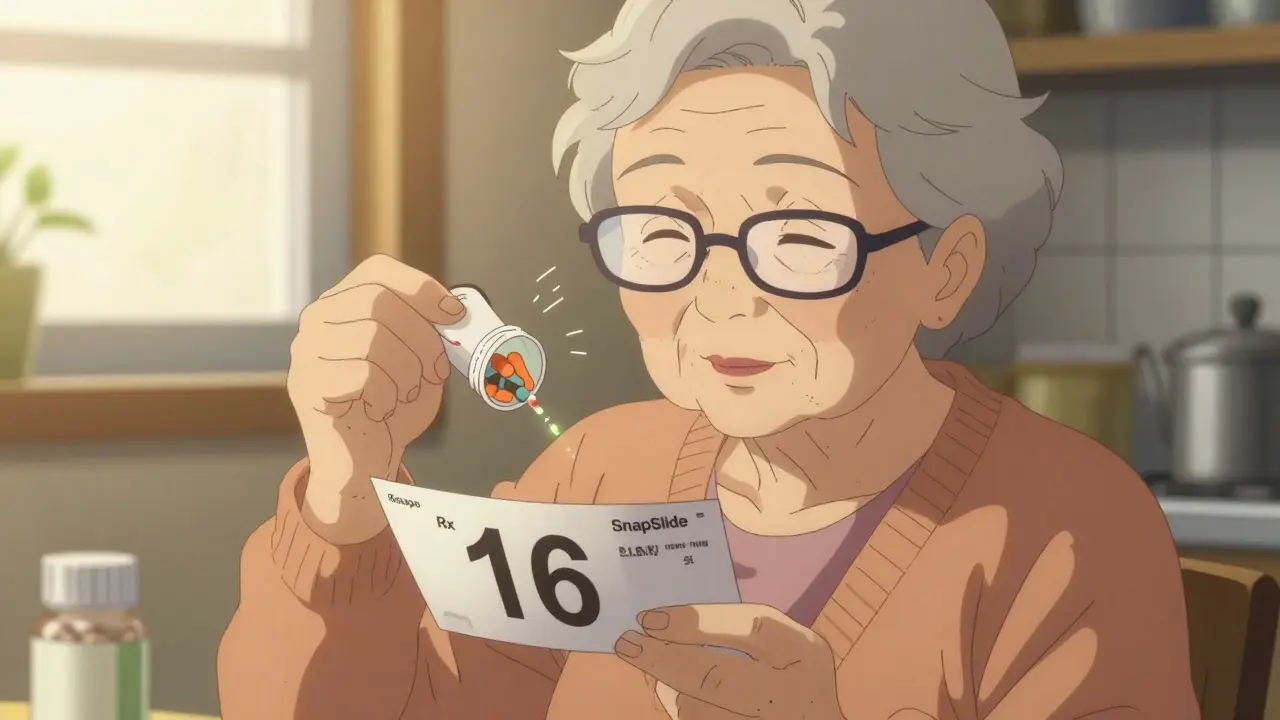
Every year, millions of older adults struggle to open their medicine bottles. It’s not because they’re weak-it’s because the caps were designed to keep kids out, not to fit arthritic hands, shaky fingers, or limited vision. If you or someone you care about has trouble turning a child-resistant cap, reading tiny print, or knowing which pill is which, you’re not alone. And you don’t have to accept it. By law, pharmacies in the U.S. must provide easy-open caps and accessible labels when you ask. No doctor’s note required. No excuses.
Why Standard Prescription Caps Are Hard to Open
Child-resistant packaging became law in 1970 to stop kids from accidentally swallowing pills. The goal was good: reduce poisonings. But today, nearly half of adults over 65 say they can’t open those same caps. That’s not a small problem-it’s a public health crisis. People skip doses. They take too much. They give up. And it’s often because the bottle won’t open. Standard push-and-turn caps require 4.5 to 8.5 pounds of downward pressure while twisting. That’s like pressing down hard on a door handle while turning a stubborn jar lid. For someone with arthritis, Parkinson’s, or even just weak grip strength, that’s impossible. Even squeeze-and-turn caps demand 6 to 10 pounds of radial force-more than most seniors can manage. The FDA’s 2022 report found that 49% of seniors over 65 struggle with standard caps. Meanwhile, 68% of visually impaired users have made a medication error because they couldn’t read the label. These aren’t just inconveniences. They’re life-threatening.What Easy-Open Caps Actually Look Like
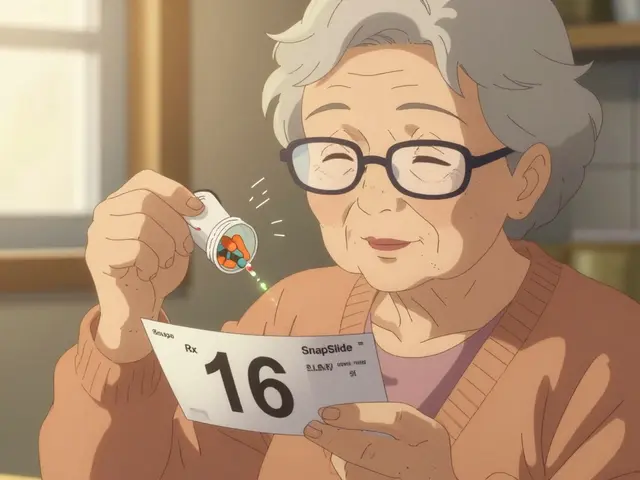
Not all easy-open caps are the same. The best ones don’t sacrifice child safety-they just make it easier for adults to open them. Here are the main types you can ask for:- SnapSlide Rx: A sliding mechanism that opens with less than 2.5 pounds of force. No twisting. Just push and slide. It’s been tested by the University of Scranton and works for 87% of seniors with arthritis. It still blocks 94% of children under five.
- Flip-top caps with large serrations: These look like regular caps but have big ridges for better grip. They’re easier to hold and twist. Some still meet child-resistance standards.
- Cold-seal wallet packs: These are blister packs sealed with a peelable film. No cap at all. Just peel open. Used mostly for pills, they reduce opening force by 40% and are gaining traction in Europe and the U.S.
- Push-button caps: Press a button on the side while turning. Less force needed than traditional caps.
Accessible Labels: Big Print, Braille, and Audio
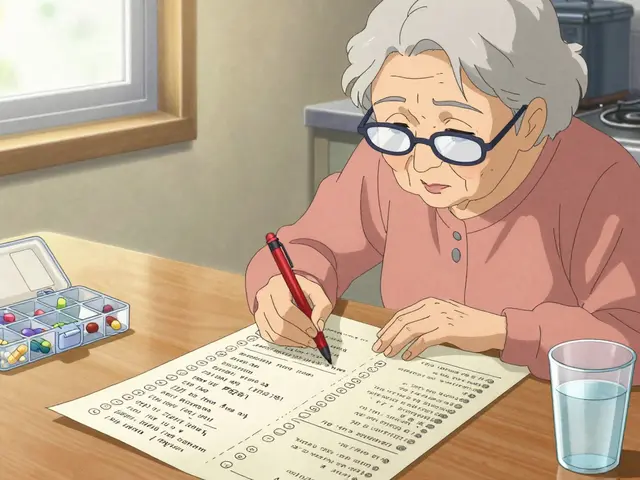
If you can open the bottle but can’t read what’s inside, you’re still at risk. Standard prescription labels use 10- to 12-point font. That’s too small for most seniors. The Access Board’s 2019 guidelines say accessible labels must use at least 16-point font. That’s almost double the size. You can also request:- Large-print labels: Printed in bold, high-contrast black on white or yellow. Some pharmacies even offer color-coded bands on the cap to match the label (e.g., blue band = blue label = blood pressure pill).
- Braille labels: Required by law if requested. Must follow Grade 2 Braille standards with 0.5mm dot height. Not all pharmacies offer this-but they must if you ask.
- Audible labels: Some pharmacies offer QR codes or phone-based systems that read the label aloud when scanned or called. The audio must cover all instructions, dosage, and warnings within 90 seconds.
How to Ask for Accessible Packaging (Step by Step)
You don’t need to be an expert. You don’t need a doctor’s note. You just need to speak up. Here’s how:- Ask at the time of prescription: Don’t wait until pickup. Call the pharmacy when your doctor sends the prescription. Say: “I need easy-open caps and large-print labels for this medication.”
- Be specific: Don’t just say “I need it easier.” Say: “I need SnapSlide caps and 16-point font labels.” If you don’t know the name, say: “I need caps that open with a slide, not a twist.”
- Know your rights: The Access Board’s 2019 guidelines say pharmacies must provide accessible packaging upon request. No documentation needed. If they say you need a note, say: “I’m not required to provide one under federal guidelines.”
- Plan for delay: Most pharmacies need 24 to 72 hours to get the right packaging. Ask when it’ll be ready. Don’t assume it’s in stock.
- Follow up: If they forget, call again. Don’t be shy. You’re not asking for a favor-you’re exercising your legal right.
What to Do If a Pharmacy Refuses
Sometimes, you’ll get a “no.” Maybe they say, “We don’t carry those.” Or, “It’s too expensive.” Or, “We don’t have inventory.” None of these are legal excuses. Here’s what to do:- Ask to speak to the pharmacist in charge. Front desk staff often don’t know the rules.
- Ask for a manager. Say: “I’m requesting accessible packaging under the Access Board’s 2019 guidelines. Can you help me get this?”
- If they still refuse, file a complaint with your state pharmacy board. You can find contact info online in minutes.
- Call the National Council on Aging’s Medication Access Hotline at 1-800-555-0123. They’ve helped 12,500 people in early 2024 alone-with a 94% success rate.
Why This Matters Beyond Convenience
This isn’t just about opening a bottle. It’s about staying healthy. A Kaiser Permanente study of 15,000 seniors found that switching to easy-open caps and accessible labels improved medication adherence by 32%. That means fewer hospital visits. Fewer ER trips. Fewer complications. The cost of these packages is 15-20% higher than standard ones. But Medicare Part D now covers that extra cost for beneficiaries with documented dexterity or vision issues. That’s new in 2024. If you’re on Medicare, you’re eligible. The market is changing fast. CVS now offers accessible packaging in all 10,000+ of its locations. The FDA is drafting new rules that will require all new prescriptions to come with accessibility features by 2026. The European Union just made it mandatory. The U.S. is catching up.What’s Next for Prescription Packaging
In 2025, SnapSlide LLC will launch Version 2.0 of its closure-featuring biometric authentication. That means only the person who registered the cap can open it. Kids can’t. Strangers can’t. But seniors with arthritis? Still easy. The European Union’s new MDR 2024/123 rule, effective January 2025, requires all prescription packaging to be tested for both child resistance AND senior accessibility. That’s a big deal. It means manufacturers can’t just slap on a “senior-friendly” label and call it done. They have to prove it. By 2027, experts predict 65% of all prescription medications will come with built-in accessibility features. That’s up from just 28% in 2023. The change is coming. But it won’t reach you unless you ask.Final Tips to Stay Safe
- Always check the label every time you take a pill-even if you’ve taken it for years. Labels can change.
- Use a pill organizer if you take multiple meds. But only if the labels are readable.
- Keep a written list of your meds, doses, and times. Give a copy to a family member.
- If you’re helping an elderly parent, don’t assume they can open their own bottles. Test it. Watch them try.
- Don’t be afraid to switch pharmacies. If one won’t help, go to another. CVS, Rite Aid, and some independent pharmacies are more responsive than others.
Do I need a doctor’s note to get easy-open caps or accessible labels?
No. You do not need a doctor’s note, proof of disability, or any documentation to request easy-open caps or accessible labels. Under the Access Board’s 2019 guidelines, pharmacies must provide these options upon request, regardless of your medical condition. If a pharmacist says you need a note, they are misinformed. You have the right to ask, and they are legally required to comply.
Are easy-open caps less safe for children?
No. Most easy-open caps still meet child-resistance standards. For example, SnapSlide Rx caps block 94% of children under five, compared to 98% for standard caps. That’s still well above the FDA’s 90% minimum requirement. The goal isn’t to make packaging child-proof-it’s to make it child-resistant while being adult-friendly. All approved senior-friendly caps are tested to ensure they still prevent most young children from opening them.
How long does it take to get accessible packaging from the pharmacy?
Most pharmacies need 24 to 72 hours to prepare accessible packaging. This is because the special caps and labels aren’t kept on the shelf-they’re ordered from suppliers. Plan ahead. When you call in your prescription, ask when the package will be ready. If you need it urgently, ask if they can rush the order or if another location nearby has it in stock.
Can I get braille labels for my prescriptions?
Yes. Braille labels are required by federal guidelines if you request them. Not all pharmacies stock them, but they must order them for you. Ask specifically for “Grade 2 Braille” labels, which are the standard for readability. If they say they can’t provide them, ask to speak to the pharmacist-in-charge or file a complaint with your state pharmacy board. The American Foundation for the Blind can also help you locate pharmacies that reliably offer braille labels.
Does Medicare cover the cost of accessible packaging?
Yes. As of 2024, Medicare Part D covers the additional cost of accessible packaging-including easy-open caps and large-print or braille labels-for beneficiaries with documented dexterity or vision limitations. You don’t need to pay extra. Just ask your pharmacy to bill Medicare directly. If they say it’s not covered, ask them to check the latest CMS guidelines. This policy change is helping more seniors get the packaging they need.

Glendon Cone
December 29, 2025 AT 13:55Just got my insulin prescription with the SnapSlide cap yesterday. Changed my life. No more wrestling with bottles at 6 a.m. while half-asleep. Also got the big print label with a blue band for my BP med-so simple, but it stops me from grabbing the wrong pill. Pharmacist was actually chill about it too. Just asked. No drama. 🙌
Hayley Ash
December 30, 2025 AT 18:38Wow. So now we’re making medicine packaging a human rights issue? Next they’ll be adding hand-holds to toothpaste tubes. 🙄
Shae Chapman
December 31, 2025 AT 08:45Hayley, I get you’re salty but… this isn’t about ‘entitlement.’ This is about people dying because they can’t read their own meds. My grandma had a stroke last year because she took double her dose thinking the pill was for her heart. She couldn’t read the tiny font. This isn’t luxury. It’s survival. 💔
Henry Ward
January 2, 2026 AT 02:46Of course the left wants to coddle the elderly into oblivion. Next they’ll ban stairs because someone might trip. This isn’t accessibility-it’s infantilization. People used to be tougher. Now we treat seniors like fragile porcelain dolls. Pathetic.
kelly tracy
January 3, 2026 AT 11:28Henry, you’re literally the reason people don’t speak up. You sound like someone who thinks oxygen should come with a waiver. Your comment is why I’m filing a complaint with my state board tomorrow. Not because I’m dramatic-because you’re dangerous.
Sandeep Mishra
January 4, 2026 AT 12:01It’s funny how we design things for kids and forget that adults grow old too. I’ve seen my uncle spend 15 minutes trying to open a bottle of metformin. His hands shake. His vision’s blurry. He gives up. And then he doesn’t take it. That’s not laziness. That’s systemic neglect. We built a world that rewards efficiency over empathy. Time to flip the script. 🌱
Aayush Khandelwal
January 5, 2026 AT 02:33Let’s not conflate ergonomic design with performative wokeness. The SnapSlide mechanism is a brilliant case of universal design-low torque, high fidelity, minimal cognitive load. It’s not ‘special treatment’-it’s systems thinking applied to pharmacology. The EU’s MDR 2024/123 is the gold standard. We’re lagging because of regulatory inertia and pharmacy supply chain myopia. Fix the pipeline, not the blame.
Joseph Corry
January 5, 2026 AT 08:26Interesting. But let’s be honest-this is just another example of the medical-industrial complex commodifying vulnerability. The fact that Medicare now covers it means corporations realized they could charge 20% more and still profit. The real issue? Pharma doesn’t want you to be healthy. They want you to be dependent. This ‘solution’ is just a Band-Aid on a hemorrhage.
Nadia Spira
January 6, 2026 AT 21:38Wow. So now we’re validating incompetence as a lifestyle choice? If you can’t open a bottle, maybe you shouldn’t be managing your own meds. Someone else should handle it. Or maybe you need to get a caregiver. Not everyone deserves a custom pill package just because they’re old. This is slippery slope nonsense.
srishti Jain
January 7, 2026 AT 14:45my grandma died because she couldn’t open her blood thinner. no one listened. now i ask for big print every time. no excuses.
Cheyenne Sims
January 9, 2026 AT 14:12While the sentiment behind accessible packaging is commendable, the premise that pharmacies are legally obligated to provide these options without documentation is misleading. The Access Board’s guidelines are advisory, not regulatory. The ADA does not mandate specific packaging formats-only that reasonable accommodations be made upon request. Misrepresenting this as a legal right misinforms the public and undermines legitimate advocacy efforts.
Colin L
January 11, 2026 AT 03:50Look, I get it. I’ve had to help my mum with her meds for five years now. I’ve called five different pharmacies. I’ve been told ‘we don’t carry that’ three times. I’ve been told ‘it’s too expensive’ twice. I’ve been told ‘ask your doctor’ once. I finally got it right after I threatened to go to the local news station. But here’s the thing-why should I have to become a warrior just to get my mum to take her pills? Why is it so hard to make something basic, humane, and safe? Why does it take rage to get basic dignity? I’m not asking for a miracle. I’m asking for a bottle cap that doesn’t make people cry.