
Imagine you’ve been stable on a specific brand-name medication for years. Your doctor knows your body reacts best to it. But when you drop the prescription at the pharmacy, you get handed a generic version instead. This isn’t just an inconvenience; for some patients, it can be dangerous. This is where prescriber override comes into play. It is the legal mechanism that allows physicians to mandate that a specific brand-name drug be dispensed, bypassing standard generic substitution protocols.
This system exists because of a delicate balance in healthcare. On one side, we have the massive cost savings from generics. The Congressional Budget Office reported that generic drugs saved the U.S. healthcare system approximately $2.2 trillion between 2010 and 2019. On the other side, we have clinical necessity. Sometimes, a generic simply won’t do the job safely. Prescriber override is the bridge between these two worlds, allowing doctors to prioritize patient safety over cost when medically justified.
How Prescriber Override Works: The DAW Code System
To understand how a doctor forces brand dispensing, you need to look under the hood of pharmacy operations. The process relies on standardized codes known as Dispense as Written (DAW) codes, documented in the National Council for Prescription Drug Programs (NCPDP) Telecommunications Standard. These codes tell the pharmacy exactly what to do with your prescription.
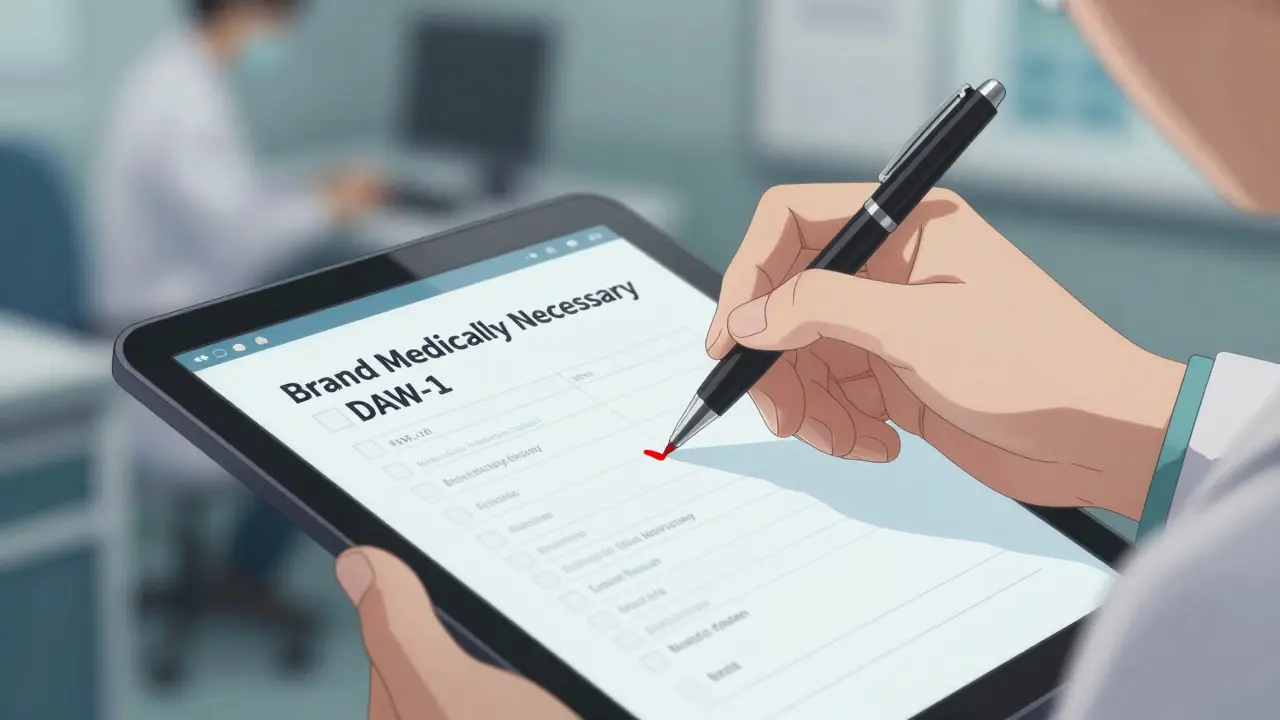
The most critical code here is DAW-1, which signifies 'Substitution Not Allowed by Prescriber.' When a physician selects this option, they are legally instructing the pharmacist not to substitute the brand-name drug with a generic equivalent. However, this isn't the only code in play. There are nine standardized options:
- DAW-1: Prescriber-mandated brand (the key override code).
- DAW-2: Patient-requested brand.
- DAW-3: Pharmacist-selected generic.
- DAW-4: Generic unavailable.
- DAW-5: Brand dispensed as generic.
- DAW-6: Override.
- DAW-7: Brand mandated by law.
- DAW-8: Generic not available in marketplace.
- DAW-9: Other reasons.
For a prescriber override to work, the DAW-1 code must be explicitly designated on the prescription. If this code is missing or incorrect, the default behavior in most states is to allow generic substitution. This means the burden of action falls squarely on the physician to ensure the correct code is transmitted electronically or written clearly on paper prescriptions.
State Laws: A Patchwork of Requirements
If you think prescriber override works the same way everywhere in the United States, you’d be wrong. The legal framework emerged following the 1984 Hatch-Waxman Act, which established the modern generic drug approval pathway but left substitution laws to the states. Today, all 50 U.S. states and territories have implemented generic substitution laws, but the rules vary wildly.
According to the National Conference of State Legislatures, 35 states operate under mandatory substitution frameworks. In these states, pharmacists are required to default to generics for multi-source drugs unless overridden. The remaining 15 states maintain permissive substitution laws, granting pharmacists more discretion. But even within mandatory states, the documentation requirements differ significantly.
| State | Required Documentation | Key Legal Reference |
|---|---|---|
| Illinois | Must mark designated 'May Not Substitute' box | Section 225 ILCS 85/25 |
| Kentucky | 'Brand Medically Necessary' handwritten on prescription | State Pharmacy Board Regulations |
| Massachusetts | 'No Substitution' notation accepted | Massachusetts General Laws |
| Michigan | 'DAW' or 'Dispense as Written' handwritten by prescriber | Public Health Code |
| Oregon | Written, telephonic, or electronic communication specifying no substitution | ORS 689.020 |
| California | 'Brand Medically Necessary' notation with prescriber signature | Business and Professions Code Section 4050-4070 |
| Texas | Two-line prescription format | Texas Administrative Code 295.201 |
This variation creates significant challenges. Dr. Jerry Avorn, Chief of the Division of Pharmacoepidemiology and Pharmacoeconomics at Harvard Medical School, noted in a 2021 commentary that "the patchwork of state-specific override requirements creates unnecessary administrative burden and potential for medication errors, particularly for physicians practicing across state lines." For a doctor moving between Illinois and Kentucky, the difference between checking a box and handwriting a phrase could mean the difference between a patient getting the right drug or the wrong one.
When Is Prescriber Override Clinically Justified?
So, when should a doctor actually use this power? It’s not just about preference. The American Pharmacists Association acknowledges that prescriber override is clinically necessary in approximately 5-7% of cases according to therapeutic guidelines. The primary scenarios include:
- Narrow Therapeutic Index (NTI) Medications: These are drugs where small differences in blood concentration can lead to treatment failure or toxicity. Examples include warfarin, phenytoin, and levothyroxine. Avalere Health's 2020 analysis showed that DAW-1 usage rates are highest in anticonvulsants (14.8%) and psychiatric medications (12.3%), reflecting these clinical concerns.
- Allergies to Inactive Ingredients: Generic drugs must have the same active ingredient as the brand, but they can use different fillers, dyes, or binders. If a patient is allergic to a specific inactive ingredient in a generic formulation, the brand may be the only safe option.
- Documented Therapeutic Failure: If a patient has tried multiple generic equivalents and experienced adverse effects or lack of efficacy, a doctor may override to return to the brand that previously worked.
The FDA's 'Approved Drug Products with Therapeutic Equivalence Evaluations,' commonly known as the Orange Book, serves as the federal reference for these determinations. While the FDA does not legally mandate its use, 42 states reference the Orange Book in their pharmacy regulations. The Orange Book assigns therapeutic equivalence codes, primarily 'A' ratings for substitutable products and 'B' ratings for those not deemed therapeutically equivalent. Pharmacists must verify this status before substituting, unless a prescriber override is in place.
The Cost and Consequences of Override Misuse
While prescriber override is vital for safety, it comes with a hefty price tag. Research published in the Journal of Managed Care & Specialty Pharmacy found that DAW-1 prescriptions cost 32.7% more on average than substituted generics. When misused, this adds up quickly. The American Pharmacists Association estimates that inappropriate override usage contributes to an estimated $7.8 billion in unnecessary annual healthcare spending.
Why does misuse happen? Often, it’s due to knowledge gaps. A national survey revealed that only 58.3% of physicians correctly understood their state's override requirements. Another 22.7% reported unintentionally allowing substitutions due to documentation errors. Dr. William Shrank, Chief Scientific Officer at UnitedHealth Group, noted that "physicians often overestimate the clinical significance of minor formulation differences between brands and generics, leading to unnecessary overrides."
Payer organizations like Pharmacy Benefit Managers (PBMs) take this seriously. Express Scripts reported that inappropriate DAW-1 designations accounted for 18.4% of avoidable brand-drug spending in their 2021 report. As a result, 87% of Medicare Part D plans and 92% of commercial health plans use DAW-1 designations as a trigger for prior authorization requirements. This means if a doctor marks DAW-1 without a strong clinical justification, the insurance company may deny coverage, requiring additional paperwork and delays for the patient.
Implementation Challenges and Real-World Failures
The theory looks good, but the reality is messy. User experiences from platforms like Sermo and Reddit highlight substantial implementation challenges. In a 2022 poll on Sermo, 63% of surveyed physicians reported difficulties with state-specific override requirements. Common complaints included inconsistent Electronic Health Record (EHR) templates that don't match state needs and pharmacies incorrectly processing override requests.
Consider the case described by a physician on Reddit in June 2023. A patient experienced therapeutic failure after a pharmacy substituted levothyroxine despite a DAW-1 designation, resulting in hospitalization for thyroid storm. This is a stark example of what happens when the system fails. The Institute for Safe Medication Practices documented 27 adverse events between 2018 and 2022 linked to inappropriate substitution of NTI drugs like warfarin and phenytoin when override instructions were improperly processed.
On the pharmacy side, technicians report that 68% of override-related claim rejections stem from improper documentation. This is especially true in states requiring handwritten notations that don't translate well to electronic prescriptions. The disconnect between EHR systems and state laws is a major pain point. According to a 2022 AMA survey, 52% of physicians reported that their EHR templates didn't match state requirements.

Best Practices for Physicians and Patients
Given these challenges, how can physicians and patients navigate the prescriber override landscape effectively? Here are practical steps based on expert recommendations and successful case studies.
- Know Your State’s Rules: Physicians should consult the National Association of Boards of Pharmacy's interactive state requirement map, which is updated quarterly. Understanding whether your state requires a checkbox, handwritten note, or specific phrasing is crucial.
- Use Standardized EHR Templates: Clinics using standardized override templates reduce override-related claim rejections by 63.2%, according to MedCentral. Work with your IT department to customize EHR templates to match local laws.
- Verify Therapeutic Equivalence: Before overriding, check the FDA Orange Book. If a generic has an 'A' rating, consider if the override is truly necessary. Reserve DAW-1 for cases with clear clinical justification.
- Communicate with Pharmacists: If a patient reports issues with a generic, document the specific reaction. This strengthens the case for override and helps justify prior authorization if needed.
- Educate Patients: Explain why a brand is being prescribed. Patients who understand the clinical rationale are less likely to push back on higher costs or prior authorization hurdles.
A 2022 case study published in the Journal of the American Pharmacists Association showed that a standardized DAW documentation protocol reduced override-related medication errors by 42.3% across 15 clinics in Michigan. This proves that systematic approaches work.
Future Trends: Toward Standardization
The current patchwork system is unsustainable. Future trajectory points toward increased electronic standardization. NCPDP plans to integrate override requirements directly into the SCRIPT 201905 e-prescribing standard by Q3 2024. This would allow EHR systems to automatically apply the correct state-specific rules, reducing human error.
Legislative efforts are also underway. The 2023 introduction of the Standardized Prescriber Override Protocol Act in Congress aims to create uniform federal requirements for brand-name dispensing requests. Additionally, the FDA has accelerated Orange Book modernization, with version 4.0 adding biosimilar interchangeability designations that will eventually impact override protocols for biologics.
However, change takes time. The California Department of Health Care Services' Medi-Cal Rx program reported a 22.3% increase in DAW-1 usage between 2020 and 2022, suggesting continued clinical reliance on override mechanisms despite cost pressures. Until federal standardization arrives, physicians and pharmacists must remain vigilant, ensuring that prescriber override is used precisely when it matters most: to keep patients safe.
What is a prescriber override in pharmacy?
A prescriber override is a legal mechanism that allows a physician to mandate that a specific brand-name medication be dispensed instead of a generic equivalent. This is typically done using the DAW-1 code, which signals 'Substitution Not Allowed by Prescriber' to the pharmacy.
When should a doctor use a prescriber override?
Doctors should use prescriber override when there is a medical necessity, such as with narrow therapeutic index drugs (e.g., warfarin, levothyroxine), patient allergies to inactive ingredients in generics, or documented therapeutic failure with generic alternatives. It should not be used for mere preference.
Do all states have the same prescriber override laws?
No, state laws vary significantly. Some states require a checkbox, others require handwritten notes like 'Brand Medically Necessary,' and some accept electronic communications. Physicians must follow their specific state's documentation requirements to ensure the override is honored.
What is the DAW-1 code?
DAW-1 stands for 'Dispense as Written - Substitution Not Allowed by Prescriber.' It is the primary code used in the NCPDP Telecommunications Standard to indicate that the pharmacist must dispense the exact brand-name drug prescribed, rather than a generic substitute.
Does insurance cover brand-name drugs when a prescriber override is used?
Coverage varies. Many insurance plans use DAW-1 as a trigger for prior authorization, meaning the doctor must provide additional clinical justification. If the override is deemed medically necessary, the brand is usually covered, but patients may face higher copays compared to generics.
What is the FDA Orange Book?
The FDA Orange Book, or 'Approved Drug Products with Therapeutic Equivalence Evaluations,' lists approved generic drugs and their therapeutic equivalence to brand-name counterparts. It helps pharmacists and doctors determine if a generic is considered interchangeable ('A' rating) or not ('B' rating).