
Statin Side Effect Assessment Tool
This tool helps you assess whether your reported statin side effects might be due to the nocebo effect rather than a true drug reaction. Based on research from studies like SAMSON, which tracked 60 patients with statin-related symptoms, this tool provides insights based on symptom patterns.
If you experience muscle pain, weakness, or fatigue after starting a statin, this tool will help you determine if your symptoms are likely related to the medication itself or to your expectations about the medication.
More than half of people who stop taking statins do so because they think the drug is making them feel bad. But what if the medicine itself isn’t the problem? What if it’s what they expect the medicine to do?
Statin Side Effects: The Myth vs. The Data
Statin drugs like atorvastatin and rosuvastatin are among the most prescribed medications in the world. They lower LDL cholesterol, reduce plaque buildup in arteries, and cut the risk of heart attacks and strokes by up to 30%. Yet, for every three people who start a statin, one stops within a year - mostly because of muscle pain, weakness, or fatigue.
Here’s the twist: in carefully designed studies where patients don’t know whether they’re taking a statin or a sugar pill, the number of muscle complaints is nearly identical. That’s not a coincidence. It’s the nocebo effect in action.
The nocebo effect is the dark twin of the placebo effect. Instead of feeling better because you believe a treatment will help, you feel worse because you believe it might hurt. And with statins, this belief is everywhere - in TV ads, online forums, even in the fine print on prescription bottles.
The SAMSON Trial: How We Learned the Truth
In 2021, a landmark study called SAMSON changed how doctors think about statin side effects. Led by James Philip Howard at Imperial College London, it followed 60 people who had quit statins because of side effects. These weren’t people with mild discomfort - they were those who had given up after trying multiple statins and were convinced the drugs were harming them.
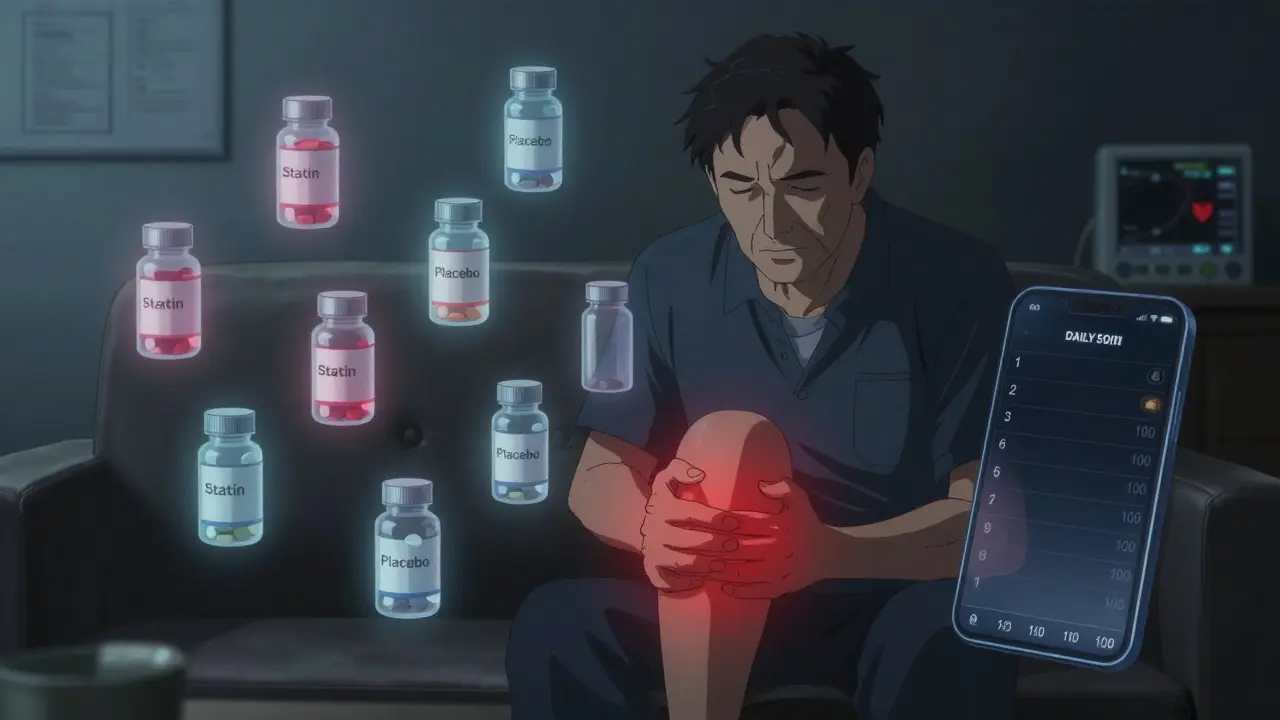
Here’s how the study worked: each person got 12 bottles over 12 months. Four had atorvastatin (20 mg). Four had placebo pills (no active ingredient). Four were empty - no pills at all. They didn’t know which was which. Every day, they logged their symptoms on a smartphone app using a scale from 0 to 100.
The results were shocking.
- Symptoms during statin months: average score of 16.3
- Symptoms during placebo months: average score of 15.4
- Symptoms during no-pill months: average score of 8.0
The difference between statin and placebo? Not statistically meaningful. The real drop in symptoms happened when there were no pills at all. That means 90% of the symptoms people blamed on statins were also happening when they took a sugar pill.
Even more telling: the timing of symptoms was identical. Pain started within days of starting either the statin or the placebo. It faded just as fast when they stopped. If it were a true drug reaction, you’d expect symptoms to build slowly, or last longer. But they didn’t. They mirrored the placebo pattern perfectly.
Why Do Statins Trigger the Nocebo Effect More Than Other Drugs?
It’s not just statins - but they’re the poster child for it. Why?
First, the side effects people worry about - muscle aches - are common in everyday life. Older adults, especially those with arthritis or inactive lifestyles, naturally get muscle soreness. When you start a statin, your brain links the two. You didn’t have pain before the pill. Now you do. So the pill must be the cause.
Second, the warnings are loud. Drug labels say muscle pain is a possible side effect. News headlines scream about statins causing weakness. YouTube videos show people quitting statins and feeling better. All of this primes your brain to expect trouble.
Third, statins are taken daily, for life. That’s a long time to be watching for symptoms. Compare that to antibiotics, which you take for 7 days. You don’t sit there wondering if each headache is from the pill. But with statins? You’re constantly monitoring.
Studies of over 80,000 people confirm this: in blinded trials, statins cause no more muscle pain than placebo. But in real-world, open-label studies - where patients know they’re on the drug - reports of muscle pain jump to 20%. The difference? Expectation.
What About Real Muscle Damage? Isn’t That Dangerous?
Yes, true statin-related muscle damage can happen. But it’s extremely rare.
- Myopathy (muscle damage with elevated CPK levels): about 5 in 10,000 people per year
- Rhabdomyolysis (severe muscle breakdown): fewer than 1 in 1 million per year
These aren’t just side effects - they’re medical emergencies. But here’s the key: they’re diagnosed with blood tests, not feelings. If your CPK levels are normal and you don’t have dark urine or extreme weakness, your pain is almost certainly not from muscle damage.
People who have real statin-induced myopathy often know it. They’ve had blood work showing CPK levels three or four times above normal. They didn’t just feel bad - their body showed it. That’s not the nocebo effect. That’s a real reaction.
But for the vast majority - over 90% - there’s no biochemical proof. Just pain. And that pain matches the pattern of placebo.
What Happens When Patients Learn the Truth?
After the SAMSON trial, researchers followed up with participants. Half of them restarted statins - and stayed on them.
Why? Because they saw their own data. They saw that their pain was just as bad on the sugar pill. They saw that when they took nothing, the pain dropped. That wasn’t a theory. It was their own experience.
One patient, a 72-year-old man from Manchester, had stopped statins after three failed attempts. He thought he was allergic to them. After seeing his symptom logs from the trial, he restarted rosuvastatin at 5 mg. Six months later, his LDL dropped from 142 to 68. He’s still on it.
Online communities like Reddit’s r/Cardiology are full of similar stories: “I thought I couldn’t tolerate statins. Then I saw my numbers. I restarted. No pain.”
But it’s not magic. It’s education. When patients understand the nocebo effect, they stop blaming the drug. They stop fearing every ache. And they start making choices based on evidence, not anxiety.

How Doctors Are Changing Their Approach
Clinicians who used to say, “Try a different statin,” are now saying, “Let’s look at your symptom patterns.”
The American College of Cardiology now recommends a structured approach for patients who claim statin intolerance:
- Rule out true muscle damage with a blood test (CPK).
- Explain the nocebo effect - simply and clearly.
- Offer a trial with placebo and no-pill periods - even if it’s just a conversation.
- Start low. Use 5 mg rosuvastatin or 10 mg atorvastatin.
- Track symptoms daily for a month.
Cardiologists who use this method report that nearly 50% of patients who had quit statins restart them successfully. Those who don’t use this approach? Only 22% get patients back on therapy.
Tools like Apple Health and Google Fit are now partnering with universities to build symptom trackers specifically for statin users. You can log pain, fatigue, sleep quality - and see if it lines up with pill days.
What This Means for You
If you’re on a statin and feel muscle pain:
- Don’t assume it’s the drug.
- Don’t stop without talking to your doctor.
- Ask: “Could this be the nocebo effect?”
- Ask for a CPK test - if it’s normal, your pain is likely not from muscle damage.
- Consider tracking your symptoms for 30 days. Note when you take the pill, when you skip it, and how you feel.
If you’ve quit statins and regret it - you’re not alone. But you might be able to get back on. You might find that the pain you thought was from the drug was really from your mind.
And if you’re still worried? Start low. Try 5 mg of rosuvastatin. Take it every other day. Track your symptoms. Give it a real shot - not because you’re told to, but because you’ve seen the data.
Statin therapy saves lives. But only if you take it. And the biggest barrier isn’t the drug. It’s the fear.
What’s Next?
Researchers are now testing whether cognitive behavioral therapy (CBT) can help reduce the nocebo effect. Early results from the SAMSON-2 trial suggest that teaching patients to reframe their thoughts about pain can cut symptom reporting by nearly half.
Pharmaceutical companies are updating patient materials. Pfizer’s statin support program now includes a section called “Your Mind and Your Medicine.” Amgen’s Repatha ads even say: “Unlike statins, which may cause symptoms due to expectation in many patients, Repatha has a different mechanism.”
That’s progress. But the real change isn’t in ads or apps. It’s in conversations. When doctors stop saying, “It’s all in your head,” and start saying, “Your brain is powerful - and it’s shaping how you feel,” patients listen.
Because the truth is simple: your body doesn’t always know the difference between what’s real and what you believe.





mark shortus
December 18, 2025 AT 15:53This is the most important medical revelation of the decade and nobody’s talking about it. I took statins for 3 years, felt like a zombie, quit cold turkey, and then realized my knee pain was from walking my dog too much. The pills were just the scapegoat. My brain was screaming ‘TOXIN’ at every twinge. Mind. Blown.
Kelly Mulder
December 20, 2025 AT 01:47While I appreciate the attempt to frame this as a ‘scientific breakthrough,’ it is, in fact, a rehashing of well-documented psychosomatic phenomena that have been acknowledged in clinical literature since the 1950s. The SAMSON trial, while methodologically sound, suffers from selection bias and lacks longitudinal follow-up. One cannot reduce complex physiological responses to mere ‘expectation’ without acknowledging confounding variables such as vitamin D deficiency, thyroid dysfunction, and mitochondrial impairment-all of which are prevalent in statin candidates. This reductionist narrative is dangerous.
Chris Clark
December 21, 2025 AT 07:02As a former EMT who’s seen 300+ patients with statin complaints, I can tell you: most of ‘em aren’t lying. But you know what? They’re not always right either. I had this one guy, 68, thought his legs were falling off-turned out he was dehydrated, had low potassium, and had been reading every Reddit thread about statin horror stories. Once we got him to log his symptoms for a week without pills? The pain dropped 70%. It’s not magic. It’s awareness. Your brain’s a loud roommate.
William Storrs
December 22, 2025 AT 05:58If you’ve ever felt like you’re failing just because your body hurts, this is your sign to breathe. You’re not weak. You’re not crazy. You’re just human. And your body listens to what you tell it. If you’ve been scared of this pill, it’s okay to feel that. But don’t let fear make the call. Talk to your doc. Try tracking. Start small. You’ve got this. I believe in you.
Guillaume VanderEst
December 23, 2025 AT 13:32Interesting. I’m from Montreal and we don’t get this kind of discussion much here. But I’ve seen it-my uncle quit statins after a bad experience, then tried them again after a doctor explained the placebo thing. He said, ‘I still feel the ache, but now I know it’s not the pill killing me.’ That’s powerful. Maybe we need more doctors who don’t just hand out scripts but hand out context.
William Liu
December 24, 2025 AT 17:19Statin therapy saves lives. But only if you take it. And the biggest barrier isn’t the drug. It’s the fear.
Frank Drewery
December 26, 2025 AT 00:37I’ve been on rosuvastatin for 8 years. Had a few muscle twinges early on. Thought I was done. Then I started logging days I took it vs. skipped. The pain didn’t care about the pill-it cared about the days I ran 5K. I didn’t know that until I saw the pattern. It’s not about the drug. It’s about listening to your body, not your anxiety.
Erica Vest
December 26, 2025 AT 01:49The SAMSON trial design was elegant, but the sample size (n=60) is statistically underpowered for generalization. Additionally, the use of self-reported symptom scores without objective biomarkers beyond CPK introduces significant measurement error. While the nocebo effect is real, it does not negate the possibility of idiosyncratic drug reactions in genetically susceptible populations (e.g., SLCO1B1 polymorphisms). A blanket dismissal of patient-reported outcomes is clinically irresponsible.
Kinnaird Lynsey
December 26, 2025 AT 19:21So… you’re saying if I stop believing the statin hurts me, the pain will magically disappear? That’s like telling a diabetic their insulin is ‘all in their head’ because they don’t have a sugar rush. Cute. I’ll stick with my CPK levels, thanks.
Andrew Kelly
December 27, 2025 AT 20:12Of course the pharmaceutical industry loves this narrative. It lets them keep selling drugs while blaming the patient’s ‘negative mindset.’ What’s next? ‘Your cancer is just a bad attitude’? The nocebo effect is real-but it’s not an excuse to ignore real toxicity. The fact that they’re now using Apple Health to track symptoms tells me they’re scared of lawsuits. Don’t be fooled.
Connie Zehner
December 27, 2025 AT 20:56I’ve been on statins for 10 years and I’ve never felt better 😍 I’m 52 and my cholesterol is 112! I started crying when I saw my LDL drop. I used to think I was broken because I felt tired. Now I know it was just my brain being dramatic. I’m so grateful I didn’t quit. 🙏
Monte Pareek
December 28, 2025 AT 04:32Look I’ve been doing this for 25 years and I’ve seen thousands of patients quit statins because they think they’re the problem. I tell them: your body’s not broken, your brain’s just loud. I give them a 30-day symptom tracker. I tell them to skip pills for a week and see what happens. I tell them to start low. I tell them to be patient. And you know what? 60% come back. Not because I convinced them. Because they saw the data. Their own data. That’s the power of evidence. Not fear. Not ads. Not YouTube. Their own numbers. That’s what changes minds.
Jedidiah Massey
December 29, 2025 AT 04:34Post hoc ergo propter hoc fallacy abounds. The nocebo effect is a convenient construct for pharmaceutical entities seeking to deflect liability for adverse drug reactions. The fact that statins inhibit HMG-CoA reductase and thereby deplete coenzyme Q10-a critical mitochondrial cofactor-is a well-established biochemical mechanism. To attribute 90% of myalgias to psychological priming is not science-it’s corporate obfuscation wrapped in placebo jargon. CPK levels are not a panacea, but neither is cognitive reframing.