Imagine picking up a prescription for high blood pressure or an antibiotic, trusting that it works exactly like the brand-name version your doctor prescribed. For decades, this trust has been the backbone of affordable healthcare. But what if the factory making that pill is cutting corners? What if the "generic" label hides serious quality flaws that could leave you untreated or worse?
This isn't just a theoretical worry. It’s a growing crisis in global pharmaceutical manufacturing. From hidden chemical impurities to factories where quality records are literally thrown away, the supply chain for generic drugs is under intense scrutiny. With 80% of active pharmaceutical ingredients (APIs) coming from facilities outside the United States, mostly in China and India, the distance between the patient and the production line has never been greater.
The Hidden Dangers Inside Generic Pills
When we talk about generic drug quality issues, we aren't just talking about pills that look slightly different. We are talking about fundamental failures in chemistry and process control. The most alarming recent example involves nitrosamines-carcinogenic impurities found in medications like valsartan.
In 2018, the FDA discovered N-nitrosodimethylamine (NDMA) in angiotensin II receptor blockers (ARBs). This wasn't a minor blip; it led to recalls affecting over 2.1 million patients across 22 countries. These impurities often form during the manufacturing process when certain chemicals react under specific conditions. If a plant doesn't monitor these reactions closely, or if they use cheaper, lower-quality starting materials, these dangerous byproducts slip into the final product.
It’s not just about impurities, though. Other technical failures include:
- Dissolution problems: The pill doesn't break down in your stomach at the right speed, meaning you get too little or too much medicine.
- Stability failures: The drug degrades faster than expected because the packaging or storage conditions weren't properly tested.
- Bioequivalence gaps: The generic version behaves differently in the body compared to the brand name, especially with Narrow Therapeutic Index (NTI) drugs like tacrolimus or warfarin, where a tiny dose difference can be life-threatening.
Why Foreign Factories Face More Scrutiny
The geography of drug manufacturing plays a huge role in quality control. The United States relies heavily on foreign sources for its medicines. According to FDA data, Chinese facilities receive 28.6% more inspection observations than U.S. facilities, while Indian facilities receive 19.3% more. Why is there such a gap?
| Region | Inspection Type | Form 483 Observations (Relative) | Key Challenge |
|---|---|---|---|
| United States | Unannounced | Baseline (100%) | Lower cost of compliance |
| China | Announced | 128.6% | Diplomatic protocols limit surprise checks |
| India | Announced | 119.3% | High volume, complex supply chains |
The biggest issue is the inspection model itself. In the U.S., FDA inspectors can show up unannounced. They see the factory as it truly operates day-to-day. Abroad, diplomatic rules often require advance notice. This gives foreign plants time to clean up, hide discrepancies, or rotate out less qualified staff. A 2023 study published in *Circulation* linked generics made in India to 23.7% more severe adverse events compared to U.S.-made equivalents, highlighting the real-world impact of this oversight gap.
Data Integrity: When Records Lie
Perhaps the most disturbing trend in manufacturing plant problems is data integrity. In 2022, poor data practices accounted for nearly 25% of all FDA Form 483 observations. This isn't just about messy paperwork; it's about scientific fraud.
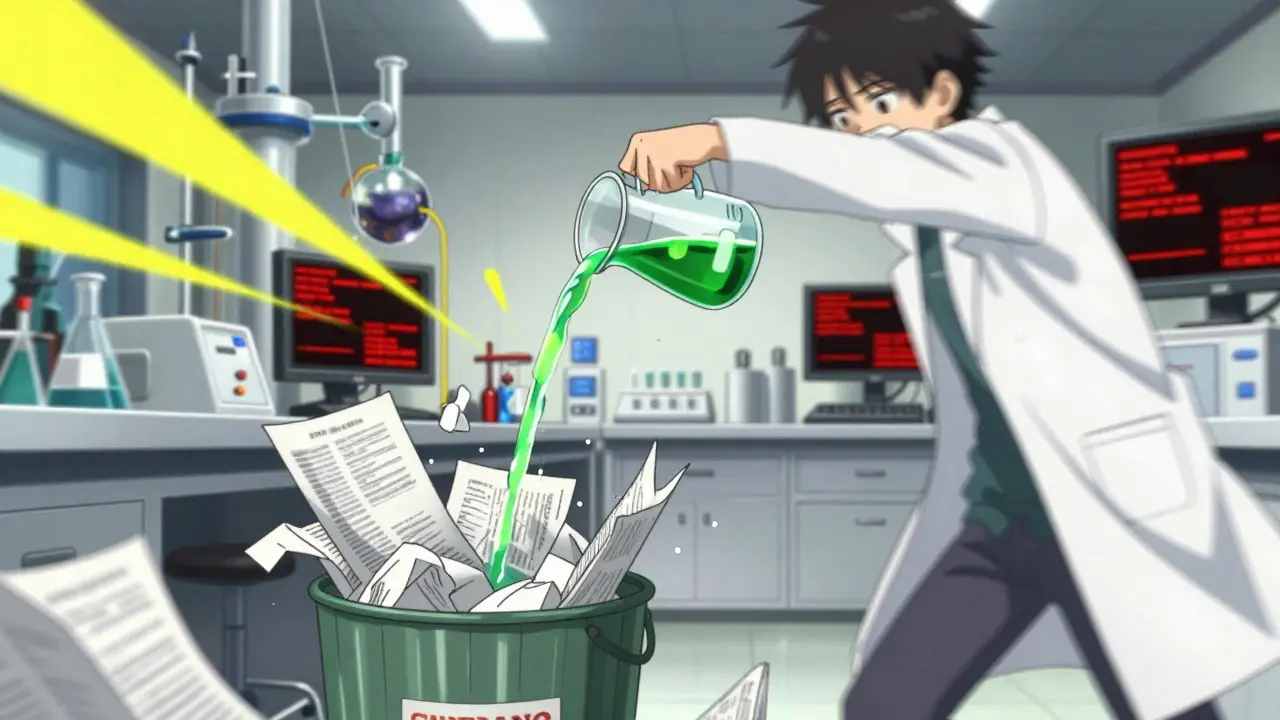
Consider the case of Intas Pharmaceuticals in Gujarat, India. During a July 2022 inspection, an employee was caught pouring acid into a trash can full of documents related to testing and quality control. Imagine trying to verify the safety of a drug when the proof of its safety has been chemically destroyed. This level of deception means regulators are often flying blind.
Common data integrity sins include:
- Lack of audit trails: Electronic systems that don't record who changed a test result and when.
- Shared passwords: Allowing multiple people to log in as one user, making it impossible to trace errors.
- Backdating results: Running tests after the batch is already released and writing down the date as if it happened earlier.
With only 0.02% of imported drug shipments undergoing actual laboratory analysis by the FDA, the agency relies heavily on these self-reported records. When those records are fake, the entire safety net collapses.
The Price of Cheap Medicine
Why do these problems persist? Money. The global generic drug market is worth over $422 billion, but prices have dropped by an average of 18.3% annually since 2018. This intense price pressure forces manufacturers to cut costs wherever they can. Often, that means reducing budgets for quality control, training, and equipment maintenance.
Implementing robust systems like Quality by Design (QbD) costs millions. The average initial implementation cost is around $2.7 million per facility, taking 18-24 months to fully integrate. For many small-to-mid-sized generic makers operating on thin margins, this investment feels risky. As a result, only 23.8% of generic manufacturers had fully implemented QbD approaches as of 2022. Without these proactive quality systems, defects are caught too late-if they are caught at all.

What This Means for Patients and Providers
You might wonder, "How does this affect me?" If you take medication for a critical condition, especially NTI drugs like levothyroxine or phenytoin, variability matters. A 2021 study in *JAMA Internal Medicine* found that 15.2% of generic drugs on the FDA Watch List showed therapeutic inequivalence. Tacrolimus capsules, for instance, showed 28.4% higher variability in blood concentration levels than their brand-name counterparts.
Hospital pharmacists are seeing this firsthand. A 2022 survey revealed that 67.3% reported at least one therapeutic failure with a generic drug in the previous year. While most generics are safe and effective, the margin for error shrinks when manufacturing standards slip. Patients may experience unexpected side effects, reduced efficacy, or allergic reactions due to inactive ingredients that differ from the brand name.
The Road Ahead: Tighter Regulations
The good news is that regulators are waking up. The FDA issued 147 warning letters for cGMP violations in fiscal year 2022, a 28.5% increase from the previous year. The European Medicines Agency (EMA) started conducting unannounced inspections at all foreign facilities supplying the EU in January 2023, leading to a 41.2% jump in critical findings. This suggests that when you catch them off guard, problems are everywhere.
The FDA is also shifting strategy. Their 2023-2027 Strategic Plan prioritizes "risk-based inspection scheduling," targeting facilities with higher risk profiles. Additionally, the Hatch-Waxman Act, which originally streamlined generic approvals, is being tightened. Proving bioequivalence for complex generics now requires 37% more testing than simple ones. This signals a clear message: shortcuts will no longer be tolerated.
For the industry, the stakes are high. McKinsey & Company projects that manufacturers investing in advanced quality systems will capture 65% of the market share by 2027. Those who ignore quality face a 40% higher risk of exiting the market entirely. The era of cheap, unchecked generic production is ending, replaced by a demand for transparency, data integrity, and rigorous scientific validation.
Are generic drugs safe to take?
Yes, the vast majority of generic drugs are safe and effective. However, quality issues do exist, particularly with complex formulations or those manufactured in facilities with poor data integrity. Regulatory bodies like the FDA continuously monitor and recall products that fail to meet standards. Staying informed about recalls and discussing any concerns with your pharmacist is a smart precaution.
What are nitrosamine impurities?
Nitrosamines are chemical compounds that can form during the manufacturing process of certain drugs. Some nitrosamines, like NDMA, are potential carcinogens. They gained attention in 2018 when they were found in valsartan, leading to widespread recalls. Manufacturers must now rigorously test for these impurities to ensure patient safety.
Why are foreign factories inspected less frequently?
Diplomatic protocols often require advance notice for inspections in foreign countries, unlike in the U.S. where inspections can be unannounced. This allows foreign facilities to prepare, potentially hiding routine deficiencies. Additionally, resource constraints mean the FDA cannot inspect every foreign facility annually, focusing instead on higher-risk sites.
What is a Narrow Therapeutic Index (NTI) drug?
NTI drugs are medications where a small change in dose can lead to treatment failure or serious side effects. Examples include warfarin, levothyroxine, and tacrolimus. Because the margin for error is so small, bioequivalence between generic and brand-name versions is critically important, making manufacturing quality even more vital for these products.
How can I check if my medication has been recalled?
You can check the FDA's official website for current drug recalls. Your pharmacist can also alert you to any issues with specific batches. If you suspect a quality issue, such as unusual appearance or unexpected side effects, contact your healthcare provider immediately and report the event to the FDA Adverse Event Reporting System (FAERS).