
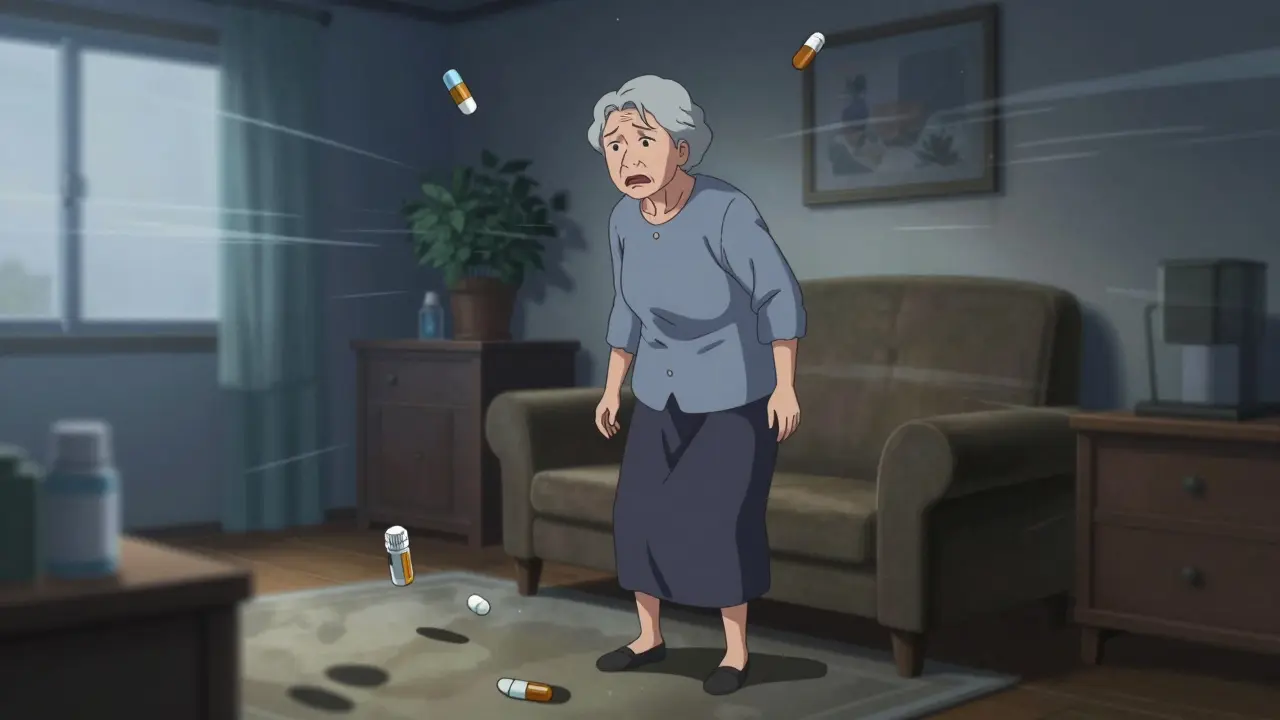
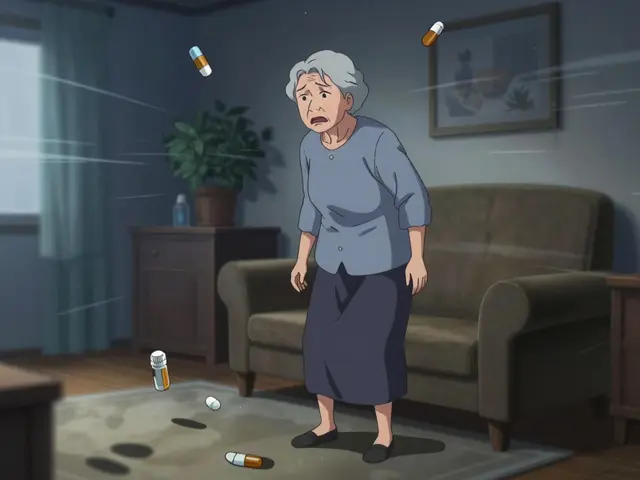
Imagine standing up from your favorite armchair to make a cup of tea. The room tilts slightly. Your legs feel like jelly. You reach for the side table, but it’s just out of reach. In that split second, gravity wins. For millions of seniors, this isn’t a hypothetical nightmare-it’s a daily reality driven not by age alone, but by the very pills meant to keep them healthy.
Falls are the leading cause of injury-related deaths among Americans aged 65 and older. But here is the shocking part: most of these falls aren't caused by tripping over rugs or weak muscles. They are caused by what's in the medicine cabinet. Research shows that between 65% and 93% of older adults who suffer fall injuries were taking at least one medication known to increase fall risk at the time of the incident. These drugs, often called Fall Risk-Increasing Drugs (FRIDs), affect balance, blood pressure, and cognition, turning a simple walk across the living room into a hazardous mission.
The Silent Culprits: Psychoactive Medications
When we think about fall risks, we often blame slippery floors or poor lighting. However, the most dangerous hazards are frequently invisible chemical changes in the brain. Psychoactive medications-drugs that affect how the central nervous system functions-are the primary drivers of medication-induced falls. This category includes antidepressants, antipsychotics, benzodiazepines, and opioids.
Benzodiazepines, commonly prescribed for anxiety and insomnia, are particularly risky. Drugs like diazepam (Valium) and lorazepam (Ativan) slow down brain activity to induce calmness or sleep. While effective for short-term relief, they impair reaction times and coordination. A systematic review published in PubMed found that benzodiazepines increase the odds of falling by 42%. Even worse, long-acting formulations stay in the body longer, creating a cumulative effect that leaves seniors groggy and unsteady well into the next day.
Antidepressants also play a significant role. Selective serotonin reuptake inhibitors (SSRIs), such as sertraline (Zoloft) and citalopram (Celexa), have been linked to a doubling of fall rates in older adults. Tricyclic antidepressants (TCAs) like amitriptyline carry an even higher risk due to their anticholinergic properties, which can cause dizziness and blurred vision. The American Geriatrics Society (AGS) explicitly warns against using TCAs in older adults whenever possible because the side effects often outweigh the benefits.
| Drug Class | Common Examples | Primary Mechanism of Fall Risk | Risk Level |
|---|---|---|---|
| Benzodiazepines | Diazepam, Lorazepam | Sedation, impaired coordination | High |
| SSRIs (Antidepressants) | Sertraline, Citalopram | Dizziness, hyponatremia (low sodium) | Moderate-High |
| Tricyclic Antidepressants | Amitriptyline | Orthostatic hypotension, anticholinergic effects | Very High |
| Opioids | Oxycodone, Hydrocodone | Drowsiness, cognitive impairment | High |
| First-Gen Antihistamines | Diphenhydramine (Benadryl) | Sedation, confusion | Moderate |
Blood Pressure Meds and the Orthostatic Trap
If psychoactive drugs cloud the mind, blood pressure medications can destabilize the body’s physical equilibrium. Many seniors take multiple drugs to manage hypertension, diabetes, or heart conditions. While these medications are life-saving, they can lead to a condition known as orthostatic hypotension.
Orthostatic hypotension occurs when your blood pressure drops suddenly upon standing up. Normally, your body constricts blood vessels to maintain pressure when you change position. Blood pressure meds, including beta-blockers (like carvedilol), ACE inhibitors (like lisinopril), and diuretics (like hydrochlorothiazide), interfere with this natural reflex. The result? A sudden rush of blood away from the brain, causing lightheadedness, tunnel vision, or fainting.
This risk spikes during dose adjustments. If a doctor increases a diuretic dosage to control swelling, the senior may lose more fluid than expected, dropping their blood pressure further. The NHS Greater Glasgow guidelines note that falls are often caused by medicines given long-term without appropriate review, meaning a drug that seemed fine six months ago might now be dangerous due to aging kidneys or liver function.
The Danger of Polypharmacy and Drug Interactions
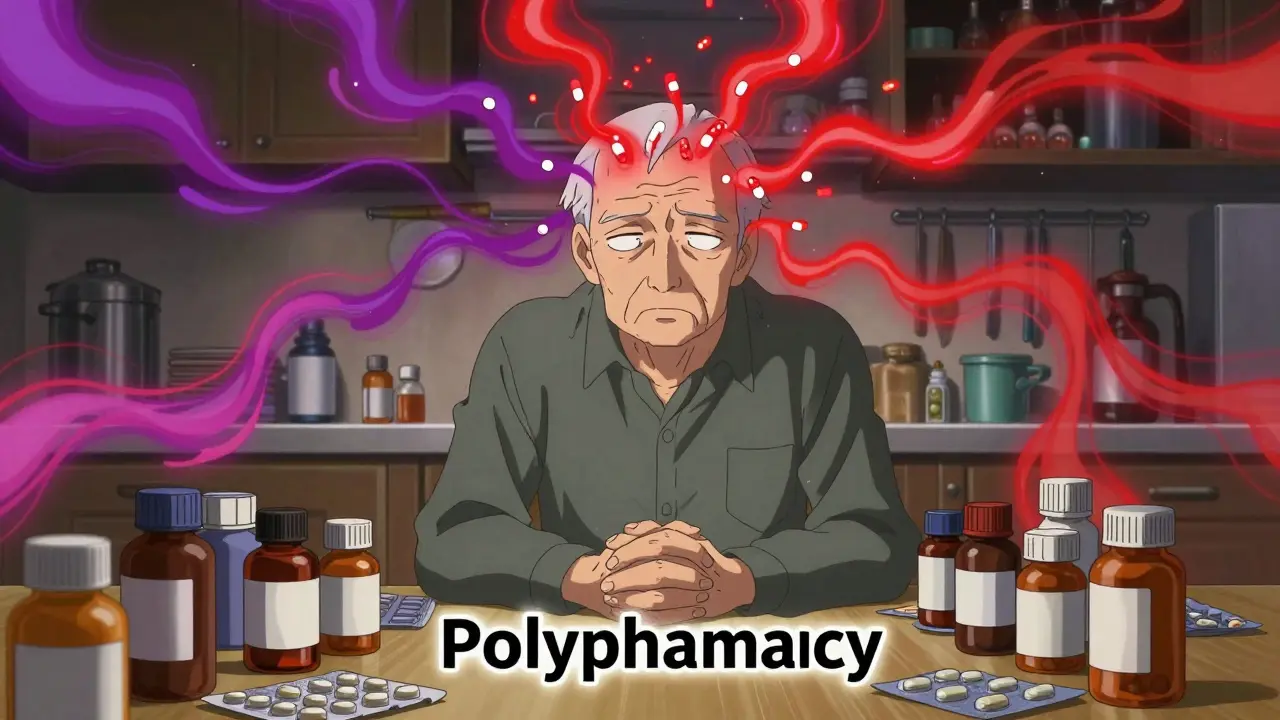
It is rarely just one pill that causes a fall. It is usually the combination. This phenomenon is known as polypharmacy, defined as taking five or more medications simultaneously. The National Council on Aging (NCOA) warns that residents taking four or more prescription drugs face a significantly increased fall risk, regardless of the specific types.
Consider this scenario: A senior takes an opioid for chronic back pain, a benzodiazepine for anxiety, and a muscle relaxant for spasms. Individually, each drug has sedative effects. Together, they create a synergistic effect that dramatically amplifies drowsiness and confusion. Dr. C. Seth Landefeld noted that combining opioids and benzodiazepines increases fall risk by 150% compared to either medication alone.
Even over-the-counter (OTC) drugs can tip the scales. Taking diphenhydramine (Benadryl) for sleep while already on an antidepressant adds another layer of anticholinergic burden. This leads to dry mouth, constipation, urinary retention, and mental fog-all of which contribute to instability and confusion, making a fall more likely.
Using the Beers Criteria to Identify Risks
How do doctors and patients know which drugs are too dangerous? The gold standard is the Beers Criteria. First published in 1991 and updated biennially by the American Geriatrics Society, this list identifies potentially inappropriate medications for older adults. The 2023 update continues to highlight fall-risk medications as a critical concern.
The Beers Criteria doesn't just say "avoid this drug." It provides nuanced guidance. For example, it suggests avoiding long-acting benzodiazepines entirely but notes that if a benzodiazepine is absolutely necessary, a short-acting one should be used at the lowest possible dose for the shortest duration. It also flags combinations to avoid, such as mixing opioids with gabapentinoids (like gabapentin or pregabalin).
Healthcare providers use tools like the START (Screening Tool to Alert to Right Treatment) and STOPP (Screening Tool of Older Persons' Prescriptions) criteria alongside the Beers list to audit prescriptions. These tools help identify not only what shouldn't be taken but also what might be missing, ensuring a balanced approach to care.

Action Plan: How to Review and Deprescribe Safely
Knowing the risks is step one. Acting on them is step two. The single most effective clinical intervention for reducing fall risk is a comprehensive medication review. Dr. Cara Cassino, a geriatrician, emphasizes that reviewing medications with all patients 65 and older is essential.
Here is a practical checklist for seniors and caregivers:
- Gather All Medications: Bring every pill bottle, supplement, and OTC product to your next appointment. Include herbal remedies, as they can interact with prescription drugs.
- Ask About Necessity: For each drug, ask: "Why am I taking this? What happens if I stop?" Many seniors continue taking medications for conditions that no longer exist or for symptoms that have resolved.
- Check for Alternatives: If a high-risk drug is prescribed, ask if a non-pharmacological alternative exists. For insomnia, cognitive behavioral therapy (CBT-I) is often more effective and safer than sleeping pills in the long run.
- Monitor Blood Pressure: If you are on blood pressure meds, check your BP lying down and then standing up after one minute. If there is a drop of 20 mm Hg in systolic pressure or 10 mm Hg in diastolic pressure, inform your doctor immediately.
- Involve a Pharmacist: Pharmacists are medication experts. Programs like HomeMeds, led by pharmacists, have demonstrated a 22% reduction in fall rates among community-dwelling older adults through structured reviews.
Deprescribing-the process of tapering or stopping medications-is not about abandoning treatment. It is about optimizing quality of life. Dr. Michael Steinman notes that reducing or eliminating fall-risk-increasing medications can decrease fall rates by 20-30% in older adults. It requires patience and close monitoring, but the payoff is stability and independence.
Future Trends and Prevention Strategies
The landscape of senior care is shifting. With fall death rates increasing by 31% between 2018 and 2021, despite no changes in physical frailty, experts are pointing to prescribing habits as a key factor. The surge in central nervous system-active drug prescriptions has created a new public health challenge.
Looking ahead, electronic health records (EHRs) are being upgraded with alerts to flag potentially inappropriate medications in real-time. By 2025, it is predicted that 75% of academic medical centers will have formal deprescribing protocols in place. However, implementation remains uneven. Only 42% of primary care physicians routinely assess medication-related fall risk, highlighting a gap in standard practice.
For individuals, the strategy remains proactive. Do not wait for a fall to happen. Treat your medication list as a dynamic document that requires regular auditing. Engage with your healthcare team, question every prescription, and prioritize safety over convenience. Your balance depends on it.
Which specific medications are most likely to cause falls in seniors?
The highest risk categories include benzodiazepines (for anxiety/sleep), tricyclic antidepressants, opioids, and certain blood pressure medications like diuretics and alpha-blockers. Over-the-counter antihistamines like diphenhydramine also pose significant risks due to sedation and confusion.
What is the Beers Criteria and why does it matter?
The Beers Criteria is a list of potentially inappropriate medications for older adults, published by the American Geriatrics Society. It helps doctors identify drugs that have high risks of side effects, such as falls, relative to their benefits in the elderly population.
Can I stop my medication abruptly if I'm worried about falls?
No, never stop prescription medications abruptly without consulting your doctor. Suddenly stopping drugs like beta-blockers, antidepressants, or benzodiazepines can cause severe withdrawal symptoms or rebound effects that are even more dangerous than the original condition.
How does polypharmacy increase fall risk?
Polypharmacy refers to taking multiple medications simultaneously. The risk increases because drugs can interact with each other, amplifying side effects like drowsiness, dizziness, or low blood pressure. For example, combining an opioid with a benzodiazepine increases fall risk by 150%.
What is orthostatic hypotension and how is it related to meds?
Orthostatic hypotension is a sudden drop in blood pressure when standing up. Many blood pressure medications prevent the body from compensating for this change, leading to dizziness or fainting. It is a major contributor to falls in seniors on hypertension treatments.
How can a pharmacist help reduce fall risk?
Pharmacists specialize in drug interactions and side effects. A pharmacist-led medication review can identify unnecessary drugs, suggest safer alternatives, and adjust dosages. Studies show such reviews can reduce fall rates by up to 22%.
Are over-the-counter sleep aids safe for seniors?
Generally, no. Most OTC sleep aids contain first-generation antihistamines like diphenhydramine, which have strong anticholinergic effects. These can cause confusion, dry mouth, and sedation, significantly increasing the risk of falls and cognitive decline in older adults.
What questions should I ask my doctor about my medications?
Ask: "Does this medication increase my fall risk?", "Are there non-drug alternatives?", "Can the dose be lowered?", and "Do any of my current medications interact negatively with each other?" Regularly request a full medication review annually.


William Storm
June 4, 2026 AT 08:14It is, frankly, a testament to the sheer intellectual bankruptcy of modern geriatric medicine that we continue to prescribe chemical sedatives as if they were candy. The article posits that these medications are 'silent culprits,' yet one might argue that the silence is deafeningly loud in the corridors of healthcare administration. To suggest that a senior citizen’s fall is merely an accident is to ignore the systemic negligence inherent in polypharmacy. We are not just dealing with slippery floors; we are dealing with a society that has decided it is easier to numb the elderly than to care for them. The Beers Criteria exists, yet it is treated as a suggestion rather than a mandate. This is not medicine; this is malpractice disguised as compassion. One must ask oneself: why do we accept such high rates of iatrogenic injury? It is because the system is broken, and we are all complicit by our silence.
Wendy Engelmann
June 5, 2026 AT 11:32I find this perspective quite illuminating, though perhaps a bit stark in its delivery. It does remind me of my own grandmother, who struggled with sleep issues and was prescribed various aids over the years. Seeing her stumble more often made us realize something wasn't right. It is comforting to know there are structured ways to review these risks, like involving a pharmacist. I think many families overlook that step, assuming the doctor has the full picture. Taking time to sit down with all the bottles really does seem like a practical first step for peace of mind.
Mike Crump
June 6, 2026 AT 08:03G’day folks! Just wanted to chime in on the polypharmacy point because it’s huge down here in Oz too. We’ve got heaps of older mates juggling five or six scripts just to get out of bed. It’s wild how doctors sometimes don’t talk to each other about what they’re prescribing. I had a mate whose GP added a new BP med without knowing he was already on a diuretic from his cardiologist. He nearly took a header at the shops! The key is definitely communication. Bring your brown bag of pills to every appointment, no matter how small. And hey, don’t be shy to ask the pharmacist for a second opinion-they’re the real experts on how these chemicals dance together. Stay safe, everyone!
Samantha Arbuckle
June 6, 2026 AT 21:35This is so important!! 🙌 I wish more people knew about the Beers Criteria. My mom was on Benadryl for years thinking it was harmless since it was OTC. Once we switched her to CBT-I for insomnia she was so much sharper and steadier. Thank you for sharing this info! 💊✨
Stephanie Francis
June 8, 2026 AT 07:32Let us be clear: this is not merely a medical issue but a societal failure. The aggressive marketing of benzodiazepines to vulnerable populations is indefensible. We see the results in our hospitals daily. The orthostatic hypotension mentioned here is a direct consequence of poor prescribing habits. Doctors must take responsibility for reviewing their patients' entire medication lists annually, not just when a new symptom arises. It is negligent to ignore the cumulative effects of these drugs. We need stricter regulations on long-acting sedatives for seniors. Enough is enough. :)
Hassan Bukhari
June 9, 2026 AT 14:53You people are missing the forest for the trees. Of course meds cause falls. Gravity causes falls. Being old causes falls. Blaming the pill is lazy journalism. Most seniors who fall have weak legs. Do some squats, grandma. The problem isn't the Valium, it's the lack of fitness. But sure, let's blame the pharmaceutical companies instead of personal responsibility. Typical.
Lenny Cruz
June 9, 2026 AT 19:52Actually, the narrative here is flawed. While the statistics cited are accurate, the implication that deprescribing is a simple solution ignores the complexity of chronic pain management. For many seniors, the quality of life provided by opioids or benzodiazepines outweighs the risk of a minor fall. Furthermore, the 'synergistic effect' mentioned is often overstated in lay terms. The body adapts. What looks like negligence is often a careful balancing act between mobility and stability. You cannot simply remove the crutch without ensuring the leg can bear the weight. The article presents a black-and-white view of a gray area. It is intellectually dishonest to suggest that all FRIDs should be eliminated. Some are necessary evils. The focus should be on monitoring, not eradication. Also, the idea that EHRs will solve this by 2025 is naive. Technology does not fix bad decision-making.
Alyssa Zucker
June 10, 2026 AT 16:03I hear you. It feels overwhelming to think about changing things that have been working for years. I remember feeling scared when my dad suggested stopping his anxiety meds. It took a lot of trust in his doctor to make that change. But seeing him stand taller now makes it worth it. It’s a slow process, but gentle steps help.
Francis Saul
June 11, 2026 AT 01:36hey guys, just wanted to say thanks for this post. i always forget to bring my vitamins to the dr appts. gonna start doing that. also checking bp standing up sounds smart. thx for the tips!
Dave Villeneue
June 11, 2026 AT 07:29The data presented is insufficient to draw definitive conclusions regarding causality versus correlation. Orthostatic hypotension is multifactorial. Attributing falls solely to pharmacological agents ignores neurological degeneration. Your analysis is superficial. Provide peer-reviewed longitudinal studies isolating variable X (medication) from variable Y (neurological decline). Until then, this is anecdotal noise. Cease spreading misinformation.
Rachel Harrypersad
June 12, 2026 AT 13:03it’s sad how we treat aging like a disease to be cured with pills instead of a natural state to be managed. we are poisoning ourselves slowly. the whole system is designed to keep us dependent. i feel exhausted just reading about all these interactions. why can’t we just rest? why do we need to be 'productive' until the day we die? it’s tragic really. we lose our balance and our minds all at once. nobody talks about the spiritual toll of being medicated into submission. it’s a quiet death.