
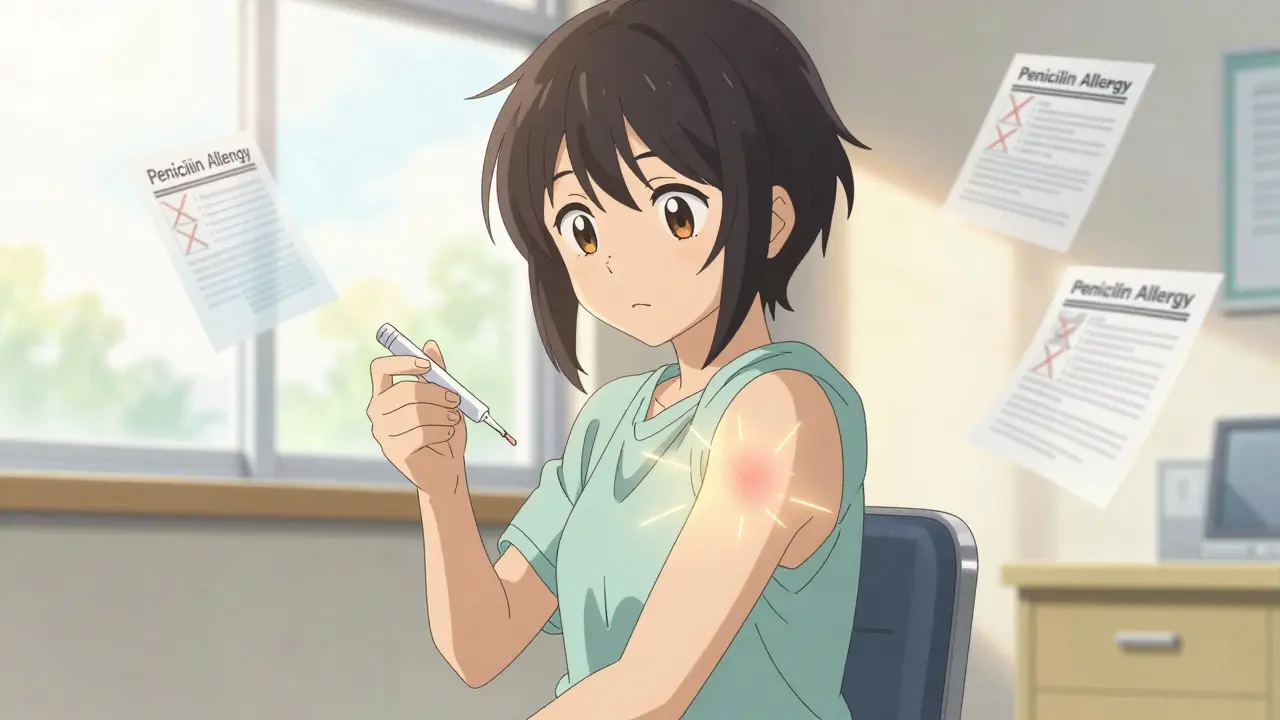
More than 1 in 10 people say they’re allergic to penicillin. But here’s the truth: 9 out of 10 of them aren’t. If you’ve been told you’re allergic to penicillin, you might be carrying around a label that’s not just wrong-it’s putting your health at risk.
Why Most Penicillin Allergies Are Misdiagnosed
Penicillin is one of the most common antibiotics ever made. Since it was discovered in 1928, it’s saved millions of lives. But today, about 10% of people in the U.S. say they’re allergic to it. That sounds serious-until you look closer.Studies show that fewer than 1% of the population actually has a true penicillin allergy. The rest? They had a rash as a kid, felt sick after taking it, or were told by a parent or doctor decades ago. Many of those reactions weren’t allergies at all. Nausea? That’s a side effect. A mild rash that faded in a few days? Often just a viral reaction. Even if you had a true reaction years ago, your body may have forgotten how to react.
Here’s what the data says: after 10 years without exposure, 80% of people who once had an IgE-mediated penicillin allergy no longer react to it. That means if you were labeled allergic as a child, you’re likely not allergic now. Yet most people never get retested. They just avoid penicillin-and all related antibiotics-forever.
The Real Danger: What Happens When You Avoid Penicillin
Avoiding penicillin sounds safe. But it’s not. When doctors can’t use penicillin, they turn to other antibiotics. These are often broader-spectrum drugs-stronger, more expensive, and more likely to cause side effects.Patients with a penicillin allergy label are 50% more likely to get a dangerous infection like MRSA. They’re 35% more likely to develop C. difficile, a severe gut infection that can lead to hospitalization or even death. Why? Because the alternatives used instead of penicillin wipe out good bacteria along with bad ones, leaving the gut wide open for harmful bugs.
Hospitals see this every day. In joint replacement surgery, patients with unverified penicillin allergies get clindamycin or vancomycin instead of cefazolin-a safer, more effective first-line drug. But those alternatives cost more, take longer to administer, and increase the risk of surgical infections. Studies show that for every 112 to 124 patients with a penicillin allergy label, one surgical infection could be prevented just by testing and de-labeling.
The cost? The U.S. healthcare system spends over $1.2 billion extra each year because of unnecessary antibiotic use tied to mislabeled penicillin allergies.
How to Tell If You Really Have a Penicillin Allergy
Not all reactions are the same. Some are harmless. Others are life-threatening. Here’s how to tell the difference:- Low-risk symptoms: Mild rash, itching, stomach upset, headache, or a reaction that happened more than 5 years ago. These are rarely true allergies.
- Moderate-risk symptoms: Urticaria (hives), swelling of the face or throat, or a reaction within the last 5 years. These need evaluation.
- High-risk symptoms: Anaphylaxis (trouble breathing, drop in blood pressure, loss of consciousness), Stevens-Johnson Syndrome, or DRESS syndrome (a severe multi-organ reaction). These require specialist care and should never be ignored.
If your history includes anything beyond a simple rash or stomach upset, don’t assume you’re allergic. Get tested.
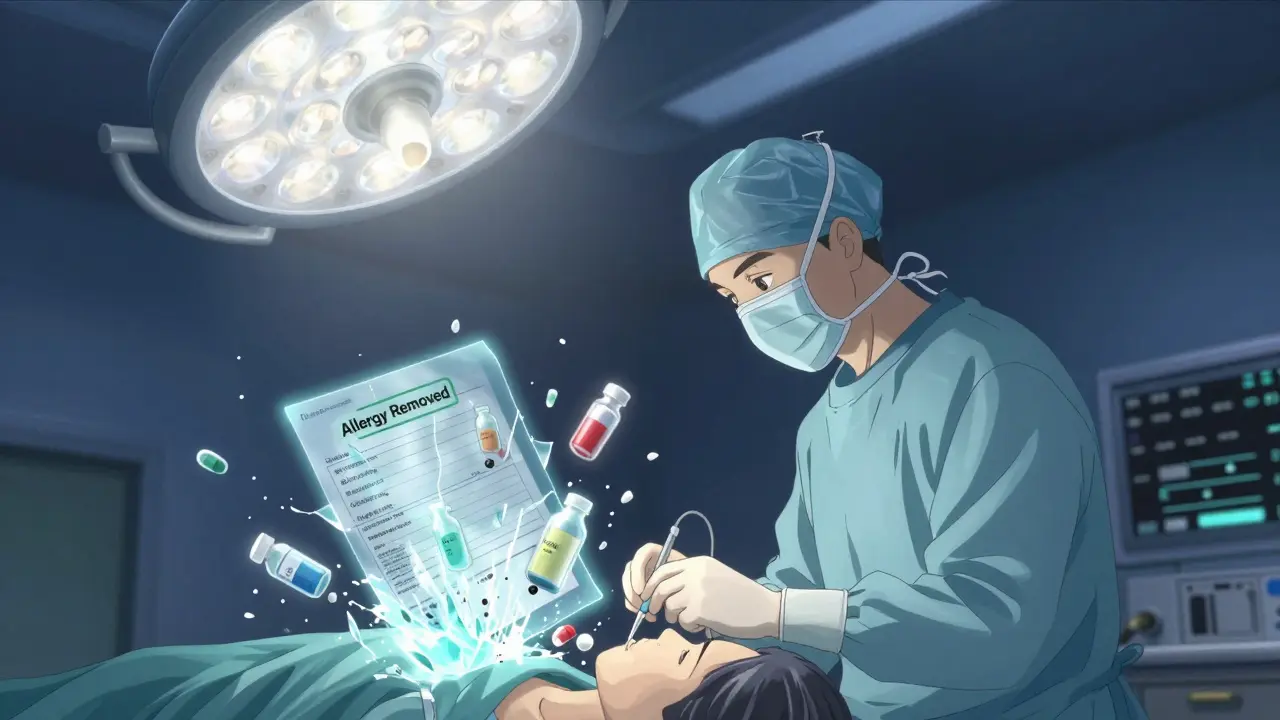
What Penicillin Allergy Testing Actually Looks Like
Testing isn’t complicated-and it’s safe when done right. Most people can be tested in an outpatient clinic or even their doctor’s office.The process has two steps:
- Skin testing: A tiny amount of penicillin and its breakdown products (called major and minor determinants) is placed on the skin and lightly pricked. If you’re allergic, a red, itchy bump appears within 15 to 20 minutes.
- Oral challenge: If the skin test is negative, you’re given a small dose of amoxicillin (usually 250 mg) and watched for at least one hour. No reaction? You’re not allergic.
If both tests are negative, your risk of anaphylaxis drops to the same level as someone who’s never claimed to be allergic. That’s not a small improvement-it’s life-changing. You can now safely use the most effective, least expensive antibiotics for infections like pneumonia, strep throat, or Lyme disease.
Many clinics now offer direct oral challenges for low-risk patients, skipping skin testing altogether. This speeds things up and makes testing more accessible. Nurses monitor your vital signs before, during, and after the dose. Emergency meds like epinephrine are always on hand.
What to Do If You Think You’re Allergic
If you’ve been told you’re allergic to penicillin, here’s what you should do next:- Check your medical records. Does it say “penicillin allergy” with no details? That’s a red flag.
- Ask your doctor: “Was this tested? What symptoms did I have?”
- If your reaction was mild or happened long ago, ask for a referral to an allergist for testing.
- If you’ve had a severe reaction, don’t try to test yourself. See a specialist.
- Don’t wear a medical alert bracelet unless you’ve had confirmed anaphylaxis or a severe skin reaction.
Many people keep the label out of fear. But the truth is, getting tested removes fear. You’ll know for sure-and you’ll open the door to better, safer treatments.

Why De-Labeling Matters
Removing an incorrect penicillin allergy label isn’t just about you. It’s about public health.When hospitals run penicillin allergy de-labeling programs, they see results fast. In some hospitals, 80 to 90% of patients with a penicillin allergy label turn out to be non-allergic after testing. Once labeled correctly, those patients get better antibiotics. Their infections clear faster. Their hospital stays get shorter. Their risk of drug-resistant infections drops.
By 2025, half of U.S. hospitals are expected to have formal penicillin allergy assessment programs. That’s because the evidence is clear: testing saves lives and money.
If you’ve been avoiding penicillin for years, you’re not being careful-you’re being misinformed. And you’re not alone. But now you know the truth. The next step? Ask for a test.
What to Tell Your Doctor
When you talk to your doctor, be specific. Don’t say, “I’m allergic to penicillin.” Say:- “I had a rash after taking penicillin when I was 8.”
- “I felt sick to my stomach and got dizzy once, but I didn’t break out in hives or have trouble breathing.”
- “I was told I was allergic, but I don’t remember the details.”
That kind of detail helps your doctor decide if you’re low-risk and eligible for a direct challenge. It also helps them update your records correctly.
And if you pass the test? Make sure your doctor updates your chart. Ask for a written note. Give a copy to your pharmacist. Tell your family. This isn’t just a medical update-it’s a safety upgrade.
What Happens After Testing
If you test negative, you’re cleared. You can take penicillin, amoxicillin, and related antibiotics like ampicillin or cefazolin without fear. You can even take cephalosporins and carbapenems-drugs once thought risky for penicillin-allergic patients-if you didn’t have a severe IgE-mediated reaction.Keep a copy of your test results. Some pharmacies still flag you as allergic even after testing. If that happens, show them your documentation. You have the right to accurate medical records.
And if you ever need antibiotics in the future-whether for an ear infection, a tooth abscess, or surgery-you’ll know you’re getting the best possible treatment. Not the backup plan. Not the riskier, costlier option. The right one.





Phil Maxwell
January 24, 2026 AT 20:38I never thought about this before, but my mom always said I was allergic to penicillin because I got a rash as a kid. Turns out, I was probably just sick with a virus at the time. Weird how we just accept these labels without question.
Now I’m kinda glad I never had to take it - but also kinda mad I didn’t get tested sooner.
Amelia Williams
January 26, 2026 AT 05:48This is such an important topic. I work in a hospital and we see this ALL the time. Patients come in with ‘penicillin allergy’ on their chart and we’re stuck giving them clindamycin or vancomycin - which are way more expensive, less effective, and way more likely to cause C. diff. One guy had three hospitalizations in two years because of it. He got tested last year and turned out to be fine. Now he’s got a T-shirt that says ‘I’m not allergic, I’m just lucky.’
Test. Don’t assume. Your body forgets. Your doctor might not know. But you can fix it.
Viola Li
January 27, 2026 AT 15:48Oh please. So now we’re supposed to trust some random skin test over decades of medical history? What’s next? ‘Oh, you had a heart attack in 2005? Nah, you’re fine now, just eat more bacon.’
People get rashes. People get sick. People die. And now you want us to just ‘try it again’ like it’s a game of Russian roulette? No thanks. I’ll stick with my ‘label’ thank you very much.
venkatesh karumanchi
January 28, 2026 AT 19:41In India, we don’t even have access to these tests. Most people just get told ‘don’t take penicillin’ and that’s it. No allergist nearby, no clinic, no follow-up. I had a cousin who got a rash after amoxicillin at age 6 - now at 32, he still avoids all antibiotics. His last infection took 3 weeks to clear because he refused to take anything ‘related.’
It’s not just a US problem. It’s a global ignorance problem.
Vatsal Patel
January 28, 2026 AT 20:39So let me get this straight - you’re telling me that after 10 years, your immune system just… forgets? Like a bad ex? Wow. That’s poetic. And also terrifying.
Next you’ll say your childhood trauma is ‘just a phase’ and your ex still loves you.
Science is wild. But I’m not volunteering to be the guinea pig for ‘maybe I’m not allergic anymore.’
Let the brave ones try. I’ll take my clindamycin and my C. diff risk, thanks.
Kat Peterson
January 29, 2026 AT 11:42OMG I’m literally crying 😭 I had a rash at 5 and now I’m 29 and I’ve been avoiding EVERY antibiotic ever because of it. I just got diagnosed with strep throat AGAIN and my doctor was like ‘you’re allergic, so we’ll try azithromycin’ - and I just wanted to scream. Why didn’t anyone tell me this?!
Just booked my allergist appointment. This is my new chapter. 🌸✨ #PenicillinFreedom
Himanshu Singh
January 29, 2026 AT 11:55Think of it like this: your body is a library. The allergy label is a book you never read - but you kept it on the shelf anyway. Now you’re afraid to open it. But what if it was just a children’s story? What if it was never true?
Testing isn’t dangerous. Not knowing is.
You owe it to your future self to open the book.
Izzy Hadala
January 31, 2026 AT 06:42It is imperative to note that the prevalence of self-reported penicillin allergy is markedly higher than the confirmed incidence of true IgE-mediated hypersensitivity. The clinical implications of this discrepancy are substantial, particularly in surgical and infectious disease contexts. I would strongly recommend that healthcare institutions implement standardized protocols for allergy de-labeling, incorporating both skin testing and oral challenges in low-risk populations. The cost-benefit analysis is unequivocally favorable.
Furthermore, longitudinal data suggest that the majority of patients lose reactivity over time, supporting the hypothesis of immunological tolerance induction.
Marlon Mentolaroc
January 31, 2026 AT 09:29Okay but let’s be real - the real reason this isn’t fixed is because hospitals don’t want to pay for allergists. And doctors are lazy. And pharmacists still flag you even after testing because their system is stuck in 2007.
So yeah, you *can* get tested. But good luck getting your chart updated. I’ve had three negative tests. My pharmacy still won’t give me amoxicillin. They called me ‘high risk’ because my file says ‘allergy’ from 1998.
It’s not science. It’s bureaucracy.
Gina Beard
February 1, 2026 AT 18:12My mom said I was allergic. I believed her. I’m 40 now. I never got tested. I probably could’ve had a normal life.
Too late now.
siva lingam
February 3, 2026 AT 14:36penicillin allergy? more like penicillin laziness
test? nah
just keep taking the expensive stuff
who cares if you get c diff
its not like you're gonna die
or are you
Karen Conlin
February 4, 2026 AT 19:13As a nurse who’s worked in ERs and ICUs for 18 years, I’ve seen this destroy people. Not just physically - emotionally too. I had a patient, 62, who had never been hospitalized until he got MRSA because he avoided penicillin. He cried when he found out he was never allergic. Said he’d spent his whole life being ‘that guy’ who couldn’t take ‘normal’ meds.
Now he’s the one telling everyone at his senior center to get tested.
We’re not just fixing allergies. We’re fixing lives. And we’re saving money. And we’re saving antibiotics for when they really matter.
Don’t wait. Ask. Get tested. Pass it on.
Kevin Waters
February 5, 2026 AT 13:09My daughter was labeled allergic at age 4 after a rash. We never questioned it. Last year, we finally got her tested - negative. She took amoxicillin for an ear infection and was fine. She’s now 10 and she’s like, ‘Wait, so I wasn’t allergic? I just had a rash?’
She’s proud of her ‘medical detective’ badge. And I’m proud I didn’t let fear decide her health.
If you’re unsure, get it checked. It’s not a big deal. It’s a big deal not to.